Fear: Our Biggest Enemy

2 Chron 14- 16; 1 Kings 15 Fear’s stronghold

There are stories about those who start strong yet finish last. In today’s reading, we see Asa start as a faithful king, yet he becomes unfaithful at the end of his life. We struggle with these stories because, in some ways, it is a reflection of ourselves, and we fool ourselves by saying I won’t be like Asa. But, unfortunately, we are more like Asa than we care to admit.

So what went wrong with Asa? What goes wrong with us? Asa is a classic example of how we handle a crisis. It was then that Asa feared men more than God. The Proverbs author reminds us that “the fear of man is a snare, BUT he who trusts in the Lord will be exalted.” [Prov 29:25] Like Asa, we allow fear to control our decision-making.

Learn from Asa; remember this truth: men will fail you every time, but God will always be faithful. [Ps 118:8]

We could make a top ten list of why we fail, but at the number one spot is the fear of men. How do you handle the enemy of fear? Share your thoughts.

The Cost of Pride and Arrogance

1 Kings 12 to14: Listen up! Wisdom is found in the aged who have been tested and proven true, just as we test a garment or a tool. The recent destruction of the submersible seems like our story today in 1 Kings 12. A wise king raises a fool; others pay the price for our pride and arrogance. 

Solomon’s son Rehoboam sought wise counsel about how to lead the nation after his father’s passing but rejected the wisdom of the elders and listened to his young advisors.  Job remarks: “Is not wisdom found among the aged? Does not long life bring understanding?” [Job 12:12] Rehoboam, much like King Saul, did not follow Job’s advice and rejected older, more mature, and wiser people. How often do we think we know better when our older mature gray heads tell us nay or yea?

Rehoboam failed because God had prophesied to Solomon of the nation’s division because he had not wholly followed the Lord. The result was a divided kingdom, wars, and rumors of wars. All because of men’s pride and arrogance.

Paul wisely offers us this counsel: Everything was written in former times for our instruction. [Rom 15:4] May we learn from Rehoboam what “not to do and what to do?”

Prescription for the “blah days”

Psalm 86

Ps 86-88 We all have them; the blah days.  You may feel disheartened because of x,y, or z. You can’t seem to find your way out of this feeling. It just wraps its arms around you, and you just feel blah and wonder what is causing it.  Precious one, God knows and cares about your ups and downs. He knows you from the tips of your fingers to the tips of your toes. Who better to go to in times like this? 

The psalmist gives us his thoughts and advice. First and foremost, center your focus on God through prayer. Tell God how you feel and why. Be honest with God. Listen to the psalmist as he sorted his feelings out. God, You are patient, lovingly kind, and faithful. 

GOD, YOU ALONE ARE GOD! Make me wholeheartedly committed to you! [Ps 86:11]

This is how you get through those times we all experience from time to time. So when you feel like you are in the pits and facing the “one-two-three punch” day, follow these steps and find peace, reconciliation, and a renewed view of your circumstance.

Striving is like hitting potholes…

Prov 30 There is never just one pothole; they seem to go on over and over, making our ride bumpy and uncomfortable. Striving rather than being satisfied is much like that. Listen to the words of Agur in Proverbs 30. It is noted that his words are an oracle which is a burden that one is carrying or a divine utterance delivered to man, usually in answer to a request for guidance. Surely that latter definition fits here because Agur repeatedly asks God to help him because “he has not learned wisdom.” [Prov 30:3] That is a picture of one who humbly submits to God for guidance.

As the chapter progresses, we see his requests. He doesn’t want to strive for wealth because wealth can disappear in an instant. Instead, it is only through the words of God he will be purified. Agur advises others who are also facing similar situations that only God’s word is purified, tested, and proven genuine, just as Paul noted in  2Tim 3:16. The psalmist also recognized that. “Your instructions are totally reliable;” [Ps 119:160]. Finally, Agur also warns of adding to God’s divine inspiration. The Apostle John echoed those exact words in Rev 22:18.

This brings us to our question:  How is your ride today? Are you striving or satisfied with what God has given you? Do you seek God above all else?  

Man’s Downfall

2Chron 9, 1 Kings 10-11 God had blessed Solomon with great wisdom, power, and plenty. The fruit of that was broadcasted across the nations until the Queen of Sheba decided to find for herself if all she heard was true. As we say, she was flabbergasted because all she heard was true and beyond what she had heard. How would you respond if someone heard you were wise and wealthy and came to see if the story was true? God allowed this to test Solomon’s heart; would it remain true?

We are wealthy beyond words because of Jesus Christ’s gift of salvation to us. When others see and hear our testimony, what do they say? Do they give God praise as the Queen of Sheba did for God in the life of Solomon? In Solomon’s case, pride led to Solomon’s fall. His wisdom and wealth did not carry him to his death, and it may do the same for us IF we are not careful to stay faithful to God.

Today as you read this tale of woe, put yourself in Solomon’s shoes for a moment and ask; is my testimony solid and sure? Do I wholly follow the Lord? Where have I allowed this world’s gods to corrupt me so that others would turn from God rather than to God?

Self Talk

Eccl 7-12 Solomon compares and contrasts the wise and the fool; from that, we can analyze our responses, and as the author of Proverbs, King Solomon has pondered this area of thought repeatedly. His wise principles are written for all of us to consider our ways.

The Preacher walks through his daily struggles by analyzing his choices. For example, he says it is better to receive a rebuke from those who are wise than to listen to the song of fools because fools laugh at calamity but do not change their ways. He also warns us to be careful of how we respond to oppression, for if we do not face it with calm resolve and patience; we may end up responding just like the fool!

To sum up, he reminds the reader that wisdom, like an inheritance, is good. The writer of James reminds the reader that one needs wisdom and should go and ask God to will provide just what is needed for the moment.

Self Talk: Am I wise or a fool today? How do I respond to challenges? When I face the end of my life, will I have done what has been wise? 

Wise Counsel

Eccl 1-3 Solomon spent much time musing on many topics. He came to the conclusion that all this striving is futile, fleeting, and incomprehensible. Yet, unlike many of us who tend to give up, Solomon kept going back to his drawing board with this phrase “I said in my heart; I searched in my heart; and I turned my heart.” That is where we all have to go as we wander this life; go back to the source, the heart of the matter. And when he did that, he concluded that God has set eternity in man’s heart. He drew two conclusions: serving God is our highest calling, and God has made everything beautiful in its time.

Are you at that point in your thinking and your life? Solomon knew, and you can know that if you want to be wise and if you want to understand God’s ways, ask Him. James 1:5 “But if anyone is deficient in wisdom, he should ask God, who gives to all generously and without reprimand, and it will be given to him.” Remember, “God is the Father of Lights and bestows good gifts to His children.” [James 1:7] 

Mirrors only tell half the story…

Proverbs 27:19 Mirror mirror on the wall
In the fairy tale Snow White, the wicked queen talks to a mirror and asks who is the fairest of them all. The mirror replies that Snow White is the fairest because although the queen is beautiful outside, she is wicked inside. Who you are to yourself, and others is only known by your heart. You and others know you by facial recognition, but God knows you by heart. Thus both the Proverbs writer and the NT author James remind us that the mirror reveals only what is superficial, but God sees the true you.
Prov 27:19 As in water, the face is reflected as a face, so a person’s heart reflects the person.

And the author of James reminds us that if we merely listen to what God has to say about our outward and inward person, we are just like the queen before the mirror asking who is the fairest of them all. We are not truthful to ourselves and God.

James 1:23 For if someone merely listens to the message and does not live it out, he is like someone who gazes at his face in a mirror. We might just be fooling ourselves but not God. What does your mirror say to you today?

Discernment

Prov 25-26 Similitudes and Instructions

A similitude is a comparison of one thing to another. Solomon’s words in these two chapters are collected into these two categories using the word “like.” Example: “Like apples of gold in settings of silver, so is a word skillfully spoken.” [25:11] Solomon is comparing the beauty of gold and silver to how we respond to another. The point is words spoken at the right time in the right way can be accepted as the view of fruit sitting perfectly aligned on a platter. How fitting are our words to the hearing ear is the point?

Again, vs. 12, “like an earring of gold and an ornament of find gold, so is a wise reprover to the ear of the one who listens.” We know from 2Tim 3:16 that one of the ways God’s word is used is to reprove or to correct that which is in error. How are our words received? How are God’s words received?

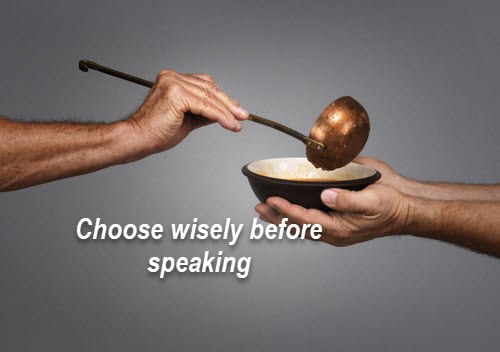
Prov 26 is the view of the wise and the fool. You wouldn’t honor a fool, for he does not understand your words. They must be constantly reprimanded, so choose your words carefully and wisely. Remember this advice from Prov 10  “Wisdom is found in the words of the discerning person…”

The point is that we must be discerning in our words and honoring people. Carefully see what the Spirit is teaching you through these comparisons. Make a list if you desire, and check yourself throughout the day.

Compromise

2Chron 8; 1 Kings 9 Compromising Solomon

Solomon conscripted the non-Israelites to work on his projects. God had said to rid the land of them, but instead, Solomon, like his predecessors, conscripted them, much like Joshua had done with the Gibeonites. What is the lesson from this? Just as God said, they would turn their hearts away from God. It happens, not at first, but spiritual fervor slowly died, just like the frog in the pan over the burner.

Solomon moved his wife, not an Israelite, but an Egyptian, into her own home. He said, “My wife must not live in the palace of the King of Israel.” Compromise brings lessoning of obedience to God’s explicit commands. At this time, just as in our own time, God came to Solomon again. He also comes quietly to speak to our hearts. He reminded Solomon of his prayer and his promise to bless him. He also reminded him of the consequences of not heeding these words. When that would take place, even the pagan nations around would ask: Why did the Lord do this? The answer was clear: “they abandoned the Lord their God.” [1Kings 9:8-9]

Is there something you vowed to do before God but out of the ease of the moment, you chose to compromise? Choose ye this day whom you will serve! [Jos 24:15]

Optimized by Optimole