Sharing the Gospel–without words

2 Kings 16-17, 2 Chron 28  We live in a neighborhood of immigrants who do not speak English. This is not a new phenomenon! 

Back in the OT times, God allowed a wicked Assyrian king to carry away the nation of Israel to his foreign land. In their place, he sent other people he had conquered who didn’t speak the language, and they brought their foreign gods and worshiped them. They did not know the custom of the God of Israel, who will not share His glory with another. [Is 42:8] God sent lions to kill them to get their attention! Today immigrants are bringing their foreign gods into our land, and they do not know the Jehovah God. He doesn’t send lions to get their attention—He sends you and I as missionaries!

The King of Assyria may have been evil, but God can and will reveal His plan to unbelievers. He revealed the problem to the king and sent a “missionary” prophet of the conquered Israelites back to tell the people about Jehovah. Just like today! You and I are “missionary” workers to bring the gospel message to the immigrants around us. Do you see yourself as a missionary to the lost around you?

What’s in a nickname?

Micah 1-7 In high school, my biology teacher called the roll and inserted a male name for mine. It stuck, and I was known by that name for the rest of my high school years. No apologies, nothing. Nicknames stick and some are less than desirable, and they hurt. Take, for example, a group of young fellows who taunted Elijah with a nickname: “baldy head,” and then there was Micah. The people had a nickname for him: ‘Oh, here comes old who is like God.” 🙁

Yet, faithful Micah repeatedly said, know God, trust God, even amid the taunts of others. Micah wanted the people to see God as a God of hope in the hardest of times. Do we look upward when life seems so out of sync? Jay Kim wrote: “Our attention is divided now more than ever because we are inundated with false ideologies and phrases.” But what about in Micah’s day? Just as then, men taunted him with: “Where is the Lord your God?” [Micah 7:10.] Micah could answer; He is where He has always been, on his throne in the heavens, and He has not changed because of this truth: “God is not a man, that he should lie, nor a human being, that he should change his mind. [Num 23:19] God’s name and nickname is Truth!

So if you are asking, where is God, look upwards because He is coming soon. Look! The LORD is coming from his dwelling place. [Micah 1:3] Are you ready to meet your God?

Then and Now

Isaiah 9-12 God graciously allowed Isaiah to see ahead 182 yrs. to the coming Messiah! [Is 9] As he writes, Babylon is not even a disciplinary force! Yet, God gave Isaiah a picture of history to prove what He has said will come to pass. History has proven it and shows us that God leaves nothing to chance. He has a plan for His people, you, and me.

The Lord will certainly have compassion on Jacob, He will resurrect Israel’s nation again, and there will be relief from suffering and anxiety. Just as God provided a lamb for Abraham instead of Isaac, He provided relief from bondage through his servant Joseph. He provided men like Isaiah, Jeremiah, and others to record His words so that we might know and trust Him. We could make lists of His provisions that, as John said: “If every one of them were written down, I suppose the whole world would not have room for the books that would be written.” [Jn 21:25]

For Isaiah, it is in the future. For us, it is in the past. Yet, God has provided this so that we may trust Him. Do you believe it? Are you looking for His return?

Doomsayers Depart!

Amos 6-9 Do you say, but I am only x, y, z? Do you not think that if God can use a sheepherder, He can use you? Or do you listen to the doomsayers who say, leave us; take your message to other people? Amos faced such backlash in Israel, which was not his home country. King Jeroboam’s priest of Bethel, Amaziah, told the king that Amos, a foreigner, was conspiring against him. Amos heard Amaziah say: “no longer prophesy at Bethel, for it is the sanctuary of the king and a royal residence.” [Amos 7:13]

Life then and life today are very much the same. We are living and moving in a growing culture of intolerance, no-platforming, safe spaces, just like Amos. Many do not want to hear the good news of the gospel. Will we be strong like Amos and reply that God has called us to tell you His good news that Jesus is the way, the truth, and the life? [Jn 14:6] Choose ye today whom you will serve. [Jos 24:15]

Or is His word like a burning fire shut up in our weary bones that must be released like Jeremiah said? Is God’s Word like an unquenchable fire in your bosom?   

Lessons from a Sheepherder

Amos 1 to 5 You may be like some who relate more to Amos, the humble Sheepherder from Tekoa, than someone who wears their Ph.D. on their sleeve.  Case in point, some years ago, I encountered a pastor who reminded me that he was to be called Dr. Jones.  Some unbelievers react that way when we wear our salvation on our sleeve rather than in word and deed.

God had a message for Israel and reveals the profound and hidden things whether we are a sheepherder or a Bible scholar. God used humble Amos to reveal a simple warning message: For three things…no make that four is his repeated refrain to the depraved Israelites who had lost their way.  

Certainly, the Sovereign Lord does nothing without first revealing his plan: He is not willing that any should perish, but all come to repentance. [Amos 3:7; 2Pet 3:9] Perhaps you feel like Amos, and you say to yourself, let someone else tell them. But God has chosen you. Others may call you or see you as foolish, but God has given you His message of His love. [1 Cor 1:27]

God is calling all sheepherders and Bible scholars: Go and tell the good news.

Perseverance “no matter what.”

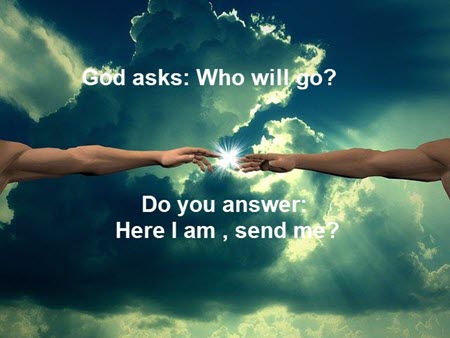
Isaiah 6 Has God called you to a task? Do you stop and ask why me? Do you ask what am I to do? Isaiah heard God ask: whom will we send, and Isaiah answered send me. He didn’t stop to ask all of the 5W’s [= who, what, where, when, why, and an H = how] questions, but he did ask, “how long?”

God answered that he was to proclaim His message until the cities were in ruins, houses uninhabited, and the land is devastated; not exactly a message that men wanted to hear. Isaiah’s response would test his stamina. His response would reveal his perseverance to what God has called him to do. Perseverance is the mark of the true believer, especially when the days drag on, few listen, and fewer believe.

Isaiah’s perseverance would last through five kingships. He would be scorned and belittled, but he remained firm. How about us? If God called you to a task, would you say yes, and would you persevere?

What is God saying to you and me?

Isaiah 1-4 Recently, a group of men entered a submersible and set off to view the Titanic. One was a billionaire, but did he know the God of Isaiah? When the submersible imploded, what good would all of his wealth do him? Could he take that wealth into eternity?  

Isaiah, God’s prophet, is asking the Israelites and us that same question. What are we doing with the abundance of wealth God has given to us? Do we invest, hoard, share, or give it away? The nation of Judah was wealthy beyond words, but they were greedily seeking to gather more and more. Like them, we find that many of us do the same, but if God were to call us to eternity would we take that wealth with us? Remember the parable in Luke 16:19-31? The rich man discovered that all of his prosperity meant nothing in eternity. How about us?

Instead of wealth Isaiah advised them to promote justice for those oppressed, just as James reminded the early church; fulfill the royal law; love your neighbor as yourself. [James 2:8]

The Sin of Pride

2 Kings 15, 2 Chron 26 Ever notice that the middle letter in pride is “I”? Pride is the deadliest of all sins and is listed as one of the sins God hates more than any other because it puts self before God. [Prov 6:16-19] It has been the cause of many a downfall. 

God blessed King Uzziah for years, but when he became strong, he also became prideful. In his later years, Uzziah entered the sanctuary to burn forbidden incense and instantly became a leper when confronted and unrepentant. He remained a leper until the day he died and was not buried in the tombs of the kings but in a field of the kings. Truly “pride goes before destruction and a haughty spirit before a fall.” [Prov 16:18]

Where is God speaking to us about our pride? Watch out for that middle letter “I.” The OT prophet Zephaniah reminds us: “Seek the Lord’s favor, all you humble people of the land who have obeyed his commands! Strive to do what is right! Strive to be humble!” [Zephaniah 2:3] Humility is what God seeks and blesses, and pride is what God detests. 

Will you go?


Jonah 1-4    Jonah is not only a Hebrew but also a Hebrew who worships the Lord, the God of heaven. Yet, Jonah is a picture of the selfish racial condemnation of others. God said in Isaiah, who will go for us and Isaiah said, “send me.” Yet, Jonah hearing that same call turns a blind eye and says, “send another, not me.” Does this sound familiar? Do we have excuses why we do not say “send me?” Look within and see why we take a ship to Tarshish and sleep away the opportunities God has placed before us. We are the Jonahs of today with our plethora of excuses.

Yet as the Psalmist said, “The Lord is merciful and fair; our God is compassionate.” [Ps 116:5] He will not relent when He has a plan to send men/women to the lost fields of Nineveh to bring them hope and the message of salvation. He may send a fish or a neighbor, or another believer to accost us in our tracks and redirect us to the lost. God is the antithesis of Jonah, and we are to be His messengers of hope as He is the God of hope.

Where is God directing you this day? To whom will you bring the message of God’s love and hope?

There are no “but’s” in God’s Vocabulary

2 Kings 14, 2 Chron 25 “But…” 

King Amaziah has been enthroned and is blessed by God “but” …yes, there is that little word “but” again showing us a contrast to something that has occurred or will occur to alter that blessing. Amaziah followed in his father’s footsteps, “but” he did not eliminate the high places where people could go to offer sacrifices. Partial obedience is still disobedience, no matter how you look at it. Amaziah obeyed the Law regarding the Commandment about punishment for a father, “but” not the children. Yet, in his pride, he overstepped his boundaries and paid the price. What boundary has God put in your life that you are testing? 

Amaziah defeated his enemies but gathered their idols and began to worship them. Do we honor God and put no other gods in His place, as the first Commandment says? Amaziah did not heed the prophet’s warning, and from the time he turned from following the Lord, he faced more defeats and was finally assassinated.

Joshua reminded us: choose ye this day whom you will serve. [Jos 24:15] There are no “but’s” in God’s vocabulary. Serve God and God only. [Deut 13:4]

Optimized by Optimole