Whom do you fear?

fear is a snare

Galatians 1 Are you a people pleaser or a God pleaser? Do you fear the condemnation of men? Whose affirmation do you seek? A people pleaser seeks the affirmation from others rather than from God. That was the charge Paul is making to the Galatians, and in turn he is asking us that same question. Will you stand apart from the crowd or will you stand firm for the cause of Christ? How were you called to salvation but by the precious blood of Jesus Christ who offered himself as bounty for our sin, once for all. 

The Galatians were being charged by some who brought to them a gospel contrary to what Paul had taught them. He was incensed by this intrusion into their new found liberty in Christ. He blatantly said these should be condemned to hell, which are pretty strong words. Why would he be so strong in his condemnation? It is because the price for our salvation was great and should be prized above all else because it freed us from the bondage of sin. 

So the question is asked again: are you a people pleaser or a God pleaser? Pray and ask God to reveal to you about this matter.

Do and Say

Mark 14 After supper when Jesus instituted the Lord’s Supper, He took them to the Garden. How is that they did not notice that Judas was not with them? And, when they saw the contingent of soldiers with Judas, how did they not connect the words of Jesus that one would betray Him? How did Peter not connect the warning to stay alert while Jesus prayed?  How often do I too miss the signs that God gives me? 

The religious leaders willingly chose to seek the death of the Righteous One thinking that if they did it on any other day than the Passover,their hands would be clean? How did they willingly forget the commandment to not murder? Again, how often do I forget the words of the Master and also choose to say and not do?

One thing God hates more than anything else is hypocrisy. I say I am a believer but do my words and actions prove that or do they say and do the contrast? How about you?

Faithful Friends

Mark 2 In chapter 1 Jesus leaves Galilee and begins his preaching career with his new disciples who have obeyed and followed Him. When Jesus calls, we must surrender and follow. They had moved from town to town quickly and after some time, they returned to Capernaum where Jesus had healed Peter’s mother in law and He had spent the night in prayer. Even though there were no town criers or newspapers or text messages, the people became aware that this man, Jesus, had returned. Many had heard, perhaps, of how he had healed and taught and so they came wondering if he would do the same here. Amongst this crowd four precious friends brought a paralyzed friend in hopes of his healing. 

The friends were persistent and left no stone unturned for when they could not enter the house, they went up on the rooftop and removed the covering to lower him to see Jesus. Unlike the religious leaders sitting listening, these friends came for the healing touch of Jesus and were not disappointed. Did they realize that Jesus would point out their sins? Probably not. They came for physical healing but went away with both physical and spiritual healing. Jesus sees the heart as well as the physical need. 

Where do you have a need that only Jesus can supply? Will you be as persistent as these four friends to bring someone to Jesus? 

Why surprised?

From blindness to sight

1Cor 1-4 If there is one thing that amazes me, it is the lack of spiritual hunger for those whose destiny speaks of hell. Just as Paul encountered those who were jealous, angry, and refused the gospel message, we see these same kinds of people today. Paul’s letter was about the cross and the Savior who died on it, but for those who reject it, the cross is seen as foolish nonsense, yet they do not realize that they are perishing.

But, for those who hear and receive the message with joy, there is joy in heaven and here on earth. They are called saints because they call upon the name of the Lord Jesus Christ. God was pleased to use the gospel message through preaching. Again, Paul reiterates that the ones who reject are the same as the Jews who see the message as a stumbling block and the Greeks who seek signs.

The blessing for those who receive the message is things that no eye has seen, ear heard, or mind imagined; these are the things God has prepared for those who seek Him early and those who love Him. [Is 64:4]

Where do you stand, friend? Have you received the message of hope in the risen Christ?

Reconciliation or Steadfast unforgiveness?

Obadiah 1, Ps 82-83 “An Unforgiving Heart” Edom is the land of Esau, the twin of Jacob. Jacob stole Esau’s birthright as well as his father’s blessing. Esau fostered this hatred throughout his nation, and they carried a bitter grudge for centuries. Outwardly, Esau acted like he forgave Jacob when he returned home, but years later assisted the Babylonians as Judah was fleeing. They were traitors to the core, all because of an unforgiving spirit.  So Obadiah writes that they will be made small, be slaughtered, face shame, be swallowed up, and be extinguished from the earth. What strong words!  

Obadiah reminds Edom that they “should not” have done what they chose to do and provides a lesson for us about cultural and racial hatred. Instead, we are to pray for those who curse and mistreat us, hoping they will turn and be saved. [Luke 6:28]  The reason is to hope “that they may seek you, O Lord…and know that you alone are the Lord, the Most High over all the earth.” [Psalm 83:16-18]

Where are we praying for cultural and racial reconciliation? Are we a part of it or a hindrance?  

The Lust of the Eyes

2Sam 10-11, 1Chron 20 What do you do as a king in the spring of the year? That is the time for battle, but David doesn’t go to war but instead lolls about on the roof of his palace. Why isn’t he off about with his men? He is bored. And boredom is the very thing that Satan desires. Idle hands are the devil’s workshop. David’s eyes are not on his men but on the lust of his eyes, and so the sight of Bathsheba only encouraged his lust, and so he did just as Eve, he saw, and he took. If that wasn’t sin enough, David then tried to cover up his sin by seeking the murder of Bathsheba’s husband, the humble and honest Uriah the Hittite. Today we call it an affair, but God calls it just what it is: adultery, and that is sin #1 because it puts lust in place of God. And just like that, David’s look ended up with taking a life that was pure and holy and tainted it with sin.

Charles Spurgeon put it like this: “As soon as ever we are conscious of sin, the right thing is not to begin to reason with the sin, or to wait until we have brought ourselves into a proper state of heart about it, but to go at once and confess the transgression unto the Lord, there and then.”

Vigilance!

Be on guard

Judges 1-2 Are we a Promise Keeper?

Peter told his readers to be vigilant because their adversary, a.k.a Satan, roams about seeking whom he can devour. [1Pet 5:8] Before Joshua died, he had forewarned them that they would not keep worshiping the Lord. And just as he said, they began to worship the idols. The angel of the Lord warned the Israelites about the dangers of making agreements with the Canaanites. And when they heard the words of the angel of the Lord, they wept. [Judges 2:4] When God reveals our sin, do we weep?

Joshua and his words now have come full circle. It will be a pattern from the beginning until the end of the book. When the enemies entered the land, the people would cry out to God. In his graciousness, He used judges to guide them, but when the judge died, the nation reverted to idolatry once again. The lesson from Judges is that a one-time promise does not mean a total commitment. What does our heart reveal?

There are several lessons for us in just these two chapters. 1. We must be on guard. We must have our spiritual armor on. 2. When God reveals our sin, we should seek His face with tears. 3. God is a promise keeper even if we are not. And 4. Prayerlessness is sin. What will we do about it?

The Consequences of Sin

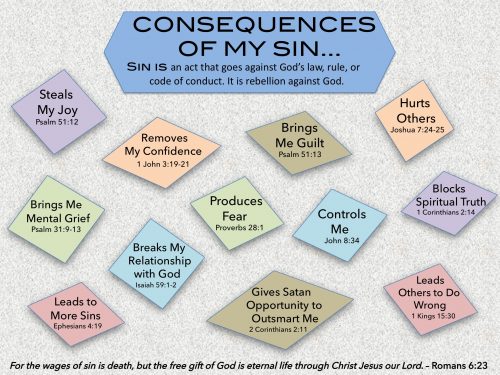
Joshua 5-8 How often are we caught with our hand in the cooky jar and plead for forgiveness? Achan saw, and coveted things from Jericho yet had been told that whatever was found was not to be taken. It was not just a thought, of oh, by the way, leave things there, but a command of God. Achan chose to ignore that command. And just like that, he saw, and he took. It is the Garden of Eden sin repeated again. And like Eve, he thought, God is a forgiving God, and He will forgive, and we can return to our life. But this was far more serious, and God would not overlook it. When you know to do right and you willingly choose not to do it is sin. [James 4:17]

Eve and Achan’s sins are similar. They knew the right thing to do but chose to disobey, and what they did not realize, and we don’t either, is that their sin affected others as well. Our sins have consequences, and often others suffer because of our choices. In Eve’s case, both she and Adam were barred from the Garden. In Achan’s case, his whole family and his possessions were burned by fire.
Numbers 32:23 says, “But if you do not do this, then look, you will have sinned against the Lord. And know that your sin will find you out.

If you have sinned, go to God and seek forgiveness lest others also face the consequences for your sin.

Photo Credit: https://buildafoundation.net/category/consequences-of-sin/

Sin and Holiness cannot co-exist!

Numbers 33 God desires a holy people. As Israel’s people near the end of their wilderness wandering, Moses takes them aside to remind them to purge the land of the idolaters and their idols. “Destroy all their carved images, all their molten images, and demolish their high places.”[Num 33:52]Then God gave them a warning: “But if you do not drive out the inhabitants of the land before you, then those whom you allow to remain will be irritants in your eyes and thorns in your side, and will cause you trouble in the land where you will be living.” Further: if you do not do what I intended to do to them, I will do it to you. [Num 33:55,56]

Yes, when we do not purge the idols in our lives, they become irritants, a constant reminder of our unwillingness to get rid of sin. Paul reminded the Ephesians to imitate God, not the other way around. We must be holy people because God is holy. Psalm 1 reminds us of how to test ourselves. Do we walk in the ways of the ungodly? Do we stand in the way of sinners? Do we sit in the seat of the scoffers? Practically, what does that mean? We must choose our associations, the places we visit, and our companions.

What choices are before us today?

The Avoidance Technique

First repent

Gen 38 Jacob’s son Judah recalls his part in selling Joseph to Ishmaelite traders, and every time he was in the presence of Jacob, he remembered his part but failed to acknowledge it. Unconfessed sin tears at our hearts, and if we fail to acknowledge it, we seek ways to avoid it, which is what Judah did.

He left home and family to stay with a pagan named Hirah. Hirah was no friend, but when we in sin, we are blind and deaf to God’s call. Unlike the Prodigal, who admitted, “Father, I have sinned against heaven and against you,” Judah became a master of the avoidance technique.  [Luke 15:18]

He met a Canaanite daughter, married, and fathered three sons, two of whom God killed because of their wickedness. Avoiding confession of sin has its consequences. Stubborn Judah has yet to acknowledge his sin and, like us, seeks to cover it up with actions, deeds, and even self-justification. He had promised his third son to his daughter-in-law, Tamar, but failed to fulfill that promise. Instead of confession, he added to his grief through sexual solicitation with her. God has a way of revealing our sins, and even though God does not excuse her deceit of prostitution, He uses that to cause Judah to acknowledge that she was more righteous than he.

Where are you carrying a past sin and have failed to acknowledge it to God?

Optimized by Optimole