Pride goeth before the fall…

2 Sam 16-18 “God is the Avenger, not us….”

2 Sam 16-18 “God is the Avenger, not us….” In Proverbs 20:11 we read: “Even a young man is known by his actions, whether his activity is pure and whether it is right,” and the contrast is also true.  Everyone knew about Absalom—it seems, except his father. David failed as a parent and did not raise him to have a godly heart. David lived by this principle: I will not touch the Lord’s anointed. But, given the opportunity, Absalom sought to shame David. He planned his demise and the takeover of his kingdom through pride, rape, and murder of his brother Amnon. A child left to himself will never find peace.

 Absalom gloated in his long hair, but in the end, it was that very prideful thing that brought him to his death. In all of this, David never cursed his wicked son nor gave anyone permission to take his life because he knew “the life of the flesh is in the blood…” [Lev 17:11] No matter what a man has done, only God has the right to take the life of a man. To do so is murder, and had he followed the advice of others, he would be like a man laden with the guilt of human blood… [Prov 28:17]

God had pronounced consequences for David’s sin, one of which was to be shamed publicly. In the end and Absalom fulfilled that prophecy. Yet, David mourned for Absalom, and we should do as well. There is no glory in the death of anyone, anywhere, anytime. Remember this truth: God is the avenger, not us.

Trusting God!

Our prayer to God

Psalms 3-4, 12-13, 28, 55

Oh how family members become the ache in our hearts!! We have raised them the best we could, yet they stray so far from the values, beliefs, morals we taught them. When they practice folly, pride, lusts, and evil, our hearts are reminded of our own mistakes and regrets for wrong choices. Yet, though all of that can be understood as a human trait, the deepest heartache is watching your children walk away from the Lord! Thus, Absolom broke David’s heart.

How did David respond? He was crushed!!! This is when grey hairs, worry lines appear and vigor wanes. The one and only top-of-the-top desire of parents is for their children to love the Lord!!!
Pray! Pray! Pray! God is God of all but reigns individually in the open hearts of people who put their faith in Him. He is still above and over the ache in our hearts for our children, regardless of their age. Trust Him with their lives.

Author: S. Stansfield

Mirrors reveal what the eye sees.

Mirrors reveal what the eye sees

2Sam 13 to 15 David’s grieving over his sin and the loss of the baby born to him and Bathsheba is a turning point in David’s reign as king. God forgives, but He still allows the consequences that we might learn from them and others might as well. From chapter 11 onward, God will show us several lessons regarding sin and its consequences that we may take heed lest we too fall prey to the enemy of sin. Where scripture is silent, we are not to speculate; therefore, our questions are irrelevant to why David did not discipline Amnon or Absalom. However, we can look and heed closely how God used his children’s errors of judgment to discipline David and to draw him closer to Himself. “These things happened as examples for us, so that we will not crave evil things as they did” [1Co 10:6]

This set of chapters is not given to us to speculate, but instead to teach us how David responded in times of crisis and show us how we are to respond. Our responses to life crises show us that we are either walking with God or apart from God. We are to look into the mirror of God’s Word to see our heart. We are to take that image and remold ourselves into the image of Christ. As James says, we are quick to respond and “forget” rather than heeding the warning that the mirror has revealed.  

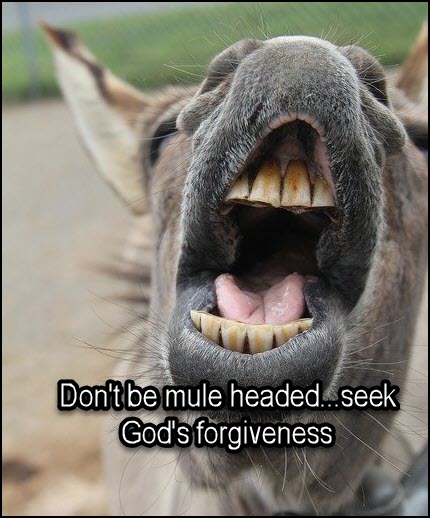
Are you Mule-Headed?

don't be a mule

Psalm 32 Mules are ornery stubborn animals. When we are stubborn and refuse to seek God’s forgiveness we say we are “mule-headed.” David pined away in his bed and kept busy throughout the day trying to forget his sin with Bathsheba and the murder of Uriah. David in his mule-headedness, refused to seek God’s forgiveness until the prophet Nathan was sent to him. Then David confessed his sin and quit trying to cover up his wrongdoing. That is the same for us. When we refuse to yield to the Spirit’s conviction, it is as if we are like a mule. But God has not given up on us so we will repent.

Verse 5 is key: David said, I will confess my rebellious acts to the Lord, and that is what we have to do as well. The man who is blessed realizes that God has forgiven his transgression.

When we refuse to yield our sin it is nothing more than pride; it is “mule-headedness.” Is your pride keeping you from admitting your sin? Come to God now and seek His forgiveness.   

SHHHHHHH…

choose wisely

Psalm 64 Whether a child or an adult, we are easily hurt by another’s words, which aim at the heart. We quote this ditty when challenged: “sticks and stones may break my bones, but words will never harm me.” But we know that is not true. Words hurt or words edify. David knew this all too well as he notes that his enemy ‘sharpens their tongues like swords; they aim their arrows, a slanderous charge.’ 

Words either edify or tear down. Words lift, and praise or words seek to destroy. Jesus said that the things that come out of the mouth originate in the heart. James reminds us that our tongue cannot be subdued; it is a restless evil, full of deadly poison. With it, we bless the Lord and Father, and with it, we curse people made in God’s image. Men face this problem. Perhaps that is why David challenged himself with these words: I will put a muzzle over my mouth, and again I will watch what I say for once words are said, they cannot be retrieved. But, also like David, we become impatient, wanting to speak our minds.

We would do well to memorize and apply Ephesians 4:29 “You must let no unwholesome word come out of your mouth, but only what is beneficial for the building up of the one in need, that it would give grace to those who hear.”

Today may we choose our words wisely.

How do you handle rejection?

How do you handle rejection?

2Samuel 10: Have you ever done something nice only not to receive a thank you but a rebuff? With a pure heart, David sent emissaries with a sympathy message at hearing the king of the Ammonites died. God sent His Son, but men have rebuffed his message of the gospel. Instead of receiving David’s message with a pure heart, the king’s son saw this as a challenge to war, whereas David had only meant peace and friendship.

There is a story in the NT about a vineyard that belonged to a king, a.k.a. God. God sent emissaries, but none were accepted. Instead, they sought to murder each representative He sent. Lastly, He sent his Son, and they killed him. These two stories are similar in many ways. God sent His Son to the vineyard, but his Son was humiliated. David sent sympathy gifts but the Ammonites rejected his overture. God sent His Son but He was rejected and ultimately crucified.

David had been more than patient with the Ammonites for what they had done earlier at Jabesh Gilead. He chose to retaliate then. God has been more than patient with his children, but there will come a time when He will act like David and retaliate.

What would we choose to do; be as David or patient as God?

From Angst to Peace

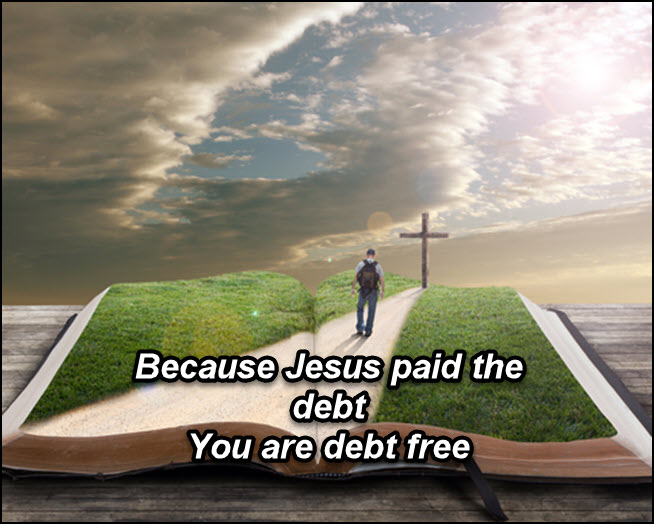
Jesus paid it all

Psalm 50 and 51 Our world is in deep trouble, yet the world says it will give you peace and security. The world lies, and if we love the world, we are not of God. [1John] Instead, we are worshiping the creation more than the Creator.[Rom 1] Jesus, God’s Son, has paid our debt and even though the world is striving to do the right “thing,” it lacks the one thing He desires: a humble spirit and a repentant heart. Without the sacrifice of our Savior, we remain indebted. But, thanks be to God that Jesus paid our sin debt.

In the OT, people brought animal sacrifices to the Tabernacle/Temple, and the High Priest would acknowledge such and pray for the individual. As temporary forgiveness, it had to be repeated over and over. On the cross, Jesus said, “it is finished,” and the veil in the temple was rent in two from top to bottom, opening the way to God. Now we can confidently approach the throne of grace to receive mercy and find grace. [Heb 4:16]Today we offer our bodies, alive, holy, and pleasing to Him, which is our reasonable service for all He has done. [Rom 12:1].

Are you still walking around with the sin label, or are you set free?

How to Handle God’s “no’s”

What do you do when God says no?

2Sam 7 & 1Chron 17 What do you do in the quiet of the moment? There is a lull now in the fighting due to the absence of Saul and his sons and David has conquered Jerusalem, making it his home. Like many of us, he sees his life passing before his eyes and realizes that although God has prospered him, he has an inner desire to do more–not for himself–but God before his days come to an end. Thus, in a time of peace, David began to see how the Tabernacle could become a permanent structure. God was pleased with David’s desire but did not allow David to build Him a permanent structure, for he was a man of war. “But God said unto me, Thou shalt not build a house for my name, because thou hast been a man of war, and hast shed blood.” [1Chr 28:3]

Even when God said no, God used Nathan to bring a message of hope to him. Your line will continue and prosper and not end as it did with Saul’s. David was overwhelmed and went and sat before the Lord to pray. Is that our attitude of humility? He is an example of how we are to respond when God says no.

How often do we cry out to the Lord; why not Lord? Or do we go in and sit before the Lord and just gaze into His eyes and yield ourselves totally to His will with a grateful heart?

Focused on Praising God

Praising God Psalm 89

Psalm 89 Psalm 23, the Doxology and the Apostles creed were part of the liturgy in the churches not too long ago as a way of focusing the parishioners toward God.

Praise God, from Whom all blessings flow;
Praise Him, all creatures here below;
Praise Him above, ye heav’nly host;
Praise Father, Son, and Holy Ghost.

Ethan the Ezrahite was focused. He said he would sing continually about the Lord’s faithful deeds, and he would share those thoughts with future generations. Think about that! Centuries ago, Ezra wrote, and today we read his words of exaltation to God in word and song. “The heavens also praise his amazing deeds as well your faithfulness in the angelic assembly.” [Ps 89:5] At the birth of our Savior, the vast, heavenly army appeared with the angels, praising God.  We don’t need to be an angel to glorify God. Enjoy Ezra’s thoughts and claim them as your own, for his words of praise can be yours as well.  Ezra reminds us that if the angelic assembly takes time to praise God, we should do that as well.  Job referenced this same thought: When the morning stars sang in chorus and all the sons of God shouted for joy. [Job 38:7]

Habakkuk reminded himself that “though the fig tree does not bud…and the fields produce no food…yet I will rejoice in the Lord.” [Hab 3:17-18] In Paul’s day he reminded the Colossians, “exhort one another with all wisdom, singing psalms, hymns, and spiritual songs, all with grace in your hearts to God.” [Col 3:16]

Today spend time praising God for who He is and for what He has done! What is your favorite hymn or praise song that you sing to give God praise?

Are you the Wheat or the Chaff?

are you wheat or chaff

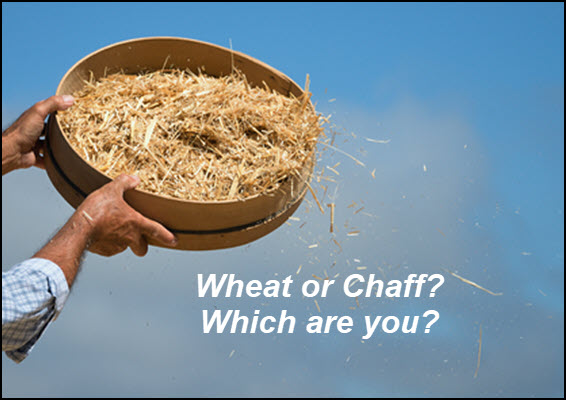
Psalms 1-2, 15, 22-24, 47 The Psalms: David as most likely the author of these psalms, reflects on the godly and the ungodly character in view of how God sees them. David contrasts the godly vs. the ungodly using an illustration from farming. The godly are busy with God’s work, and while he works, he ponders the words of God. The ungodly are like the chaff that the wind drives away.

 “Chaff is the loose, outer covering on wheat and other grains that must be separated in the threshing and winnowing process of harvesting grain. In Bible times, grain was threshed, trampled, crushed, and beaten on the outdoor threshing floor to separate the inedible parts of the grain, called chaff. The lightweight chaff would blow away on the wind or sometimes was burned as fuel. In the winnowing process, the grain was then tossed into the air, allowing the wind to separate further any remaining bits of the husk from the wheat. These bits, called chaff, would be carried away in fine particles like dust.” [explanation from gotquestions.org]

The chaff blows away or is burned—what a graphic picture of the ungodly through the eyes of the psalmist. The question then is; are you the wheat or the chaff?

Optimized by Optimole