Facade or True?

Be silent

Habakkuk 1-3 God called Habakkuk to share God’s plans for His children as they lived and wallowed in their sins. Would they repent, or would they suffer the consequences of their sins? God revealed His plans that they might know—even if they didn’t understand. How gracious is our God!

Habakkuk was disturbed that God would use the evil Chaldeans to discipline His children, but when push comes to shove, that was needed to get their attention. God does the same with us. If you won’t listen and parade around with a facade of holiness, but your heart is unrepentant, then God will reveal true wickedness through persecution. But, beware of saying you are persecuted when you are just using that as a coverup for disobedience. [Matt 5:10]

Three things Habakkuk learned from this interaction with God. One is that we can come boldly before His throne and voice our questions, and He will answer! Secondly, only the just will live by faith. Thirdly, God is still in charge and at work.

Am I standing on the wall with Habakkuk watching and listening for His voice, or am I just walking around with the mask of holiness, but if removed, it would reveal my hypocrisy of false holiness?


Two types of people

Integrity or honesty

Proverbs 19-22 There are people with integrity and those who are the scorners/scoffers. Maybe like me, you too struggle with these people. They draw my ire, and I find them to be despicable.

Now, sometimes as we read, we come across a pithy saying that tells us what God is really looking for in a person. He says scoffers bring about contention and strife, so drive them out! [Prov 22:10] and Prov 19:1 “Better is a poor person who walks in his integrity than one who is perverse in his speech and is a fool.” So we see the truth, but just as Jesus taught with examples, we also find teaching examples,

For example, King Ahab and his wife Jezebel were biblical characters that lacked integrity. They also were scoffers who scoffed at God. In sharp contrast was Naboth, the vineyard keeper, a poor man but a man of integrity. He lived next door to the palace, and he tended his land because it was his ancestral inheritance, and he would not relinquish it even for a penny—even to a king! It was not the money, but it all boiled down to integrity. But King Ahab wanted Naboth’s vineyard, so he stooped to deceit and murder to get it. God told Elijah to tell Ahab that He would bring disaster upon his ancestral line because of his sin of murder and his lack of integrity. He lacked the honesty of Naboth through and through.

The lesson for us is in the proverb: God looks for someone who exemplifies integrity, like Naboth. Am I a Naboth or King Ahab? OUCH!

Which is the greater sin?

Whose rules do you follow?

John 5 Jesus returns to Jerusalem and heals a man (on the Sabbath) by the pool of Siloam not because he sought healing but because of Jesus’ heart of compassion. The man “immediately” obeys to pick up his mat and walk. Jesus has disappeared from this scene but the religious police accost this innocent man and charge him with breaking the Sabbath.

In the book of Numbers, we read of a story of a man who truly broke the Sabbath by picking up sticks and is stoned to death. Was this on their mind? When hearing their threats, did he, too, recall that story? Picture that, and now you understand his fear; what transpires next, and why we sometimes react as he did.   

Jesus finds the innocent healed man, and he reminds him that his healing is for a purpose; that he sin no more but use his healing for a greater purpose. Yet, as Proverbs reminds us, the fear of man is greater than the fear of God. [Prov 29:25] and so he rushes to the religious leaders to betray his healer. Now we see the true intent of their heart; they sought to find him to kill him.

The religious police didn’t want the man healed on the Sabbath, but they were willing to kill Jesus. So which is the greater sin?

Boasting about God

What are you boasting in?

Jeremiah 7 -9 The heart of God and the heart of Jeremiah.

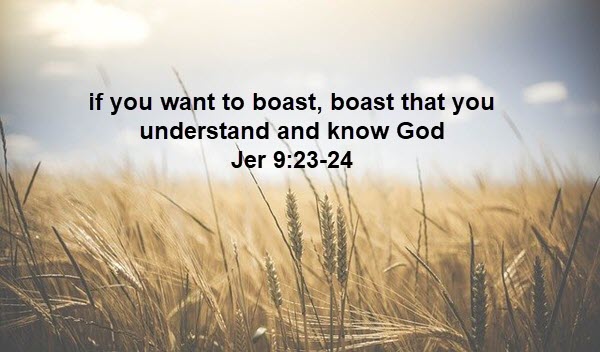
God has revealed to Jeremiah the sin of his people. They are hypocrites and have a hard heart. Jeremiah reminds them that these are the two things God hates and He will bring judgment on them because they refuse to listen and obey. At the end of chapter nine, Jeremiah reminds them that if you want to be wise and you want to glory, then look and see if you are demonstrating God’s character. What then can we “brag” or boast about? It is this: “God chose what is low and despised in the world, what is regarded as nothing, to set aside what is regarded as something, so that no one can boast in his presence” [1Cor 1:28]

 “Wise people should not boast that they are wise. Powerful people should not boast that they are powerful. Rich people should not boast that they are rich.  If people want to boast, they should boast about this: They should boast that they understand and know me. They should boast that they know and understand that I, the Lord, act out of faithfulness, fairness, and justice in the earth and that I desire people to do these things,” says the Lord. [Jer. 9:23-24]

These are the characteristics of the Lord that stand in contrast to what men boast in. What are you boasting in this a.m.?

“Which or Witch?”

Which or "witch"

1Samuel 28 Witches are products of an ungodly society and should be avoided every “witch” way we can. But, our society now, as it was in the days of Saul, seems to glorify them as we see on Halloween. Faced with the enemy all around him, Saul wants to know what lay ahead. Instead of repenting of his sin and humbling himself before God, he seeks answers every way but God’s way. By his own words, Saul recognizes that “God does not answer me anymore— not by prophets or by dreams.” [1Sam 28:15]

David Guzik explains: “God will not always answer everyone who seeks Him; not when a man is in a place of judgment as Saul is. King Saul has rejected and is currently rejecting God’s previously revealed will. Since Saul didn’t care to obey God in what he already knew, God will not give him more to know.”

What is the moral of this story? You can seek answers to your questions every “witch” way you want, or you can humble yourself before God and wait on His answer. In his distress and state of panic Saul recognized God had left him but he was unwilling to repent and get right with God first. We get to that place too, when we fail to put God first. 

The life lesson for us is this: “seek the Lord and the strength He gives. Seek His presence continually.” [Ps 24:6] Saul did not.

What Do You Need to honor God?

Honor God

Judges 17: As the Israelites moved farther and farther away from Yahweh, people began to look for other means to bring them success. Unfortunately, the principle of pursuing God’s kingdom and his righteousness has taken a back seat. Meet Micah, whose name means “who is like God,” as an example. He lived in a time when Israel had no king, and each man did what he considered right. He lived just a stone’s throw from the tent of God in Shiloh, but God’s word and principles were far from his memories of a holy lifestyle. Instead, if someone stole from you and you had the opportunity to steal back, it was rewarded with words of affirmation. How far they have fallen to have forgotten the Commandment: “Thou shalt not steal.” [Ex 20:15] Micah steals, but instead of being corrected, his mother “blesses” him and has an idol made to honor his treachery.

Next, we wonder why a Levite has left his home in Bethlehem, and he is looking for a place to stay. Micah bribes him with ten pieces of silver per year, but that loyalty only lasted until a better offer came along.

When God is absent, men do what is right in their own eyes. [Judges 17:6] Men think having something tangible will make them more holy. They look to the visible when the invisible attributes of God are clearly visible in creation. [Rom 1:20]

“Freaks, Geeks, Seek(ers)”

Luke 14 As a Master Teacher, Jesus never missed an opportunity to teach lessons we all need to learn. As an observer at a dinner party on the Sabbath, Jesus masterfully taught his host and the attendees as well as us some lessons in humility that we would be wise to emulate.

Consider the first guest who was perhaps considered the person least likely to receive an invite due to his physical condition called dropsy [edema due to congestive heart failure.]. We might call him the “town freak.”  The Pharisees invited him not because they cared about him but to watch closely to see what Jesus would do. Consider the next set of guests who sought to sit in the seats of honor. We might call them the “town geeks” because of their self-inflated ego. They miscalculated how the host saw them and found themselves humiliated when asked to move. The third lesson is to the host himself; he is the “town seek” because he is always inviting prominent persons to receive invitations back. Jesus point-blank told him that this smacks of favoritism.

Consider all of these lessons in light of what Jesus might ask us.  Who are we inviting to our homes, and why? At school or work, do we honor some and dishonor others? Do we find ourselves ignoring some while favoring others? Perhaps we can all begin to pray:

May I see others the way God sees them.

“Is Old Good Enough?”

Is this your mindset?

Luke 4&5 Are you satisfied with your life the way it is? It seems that those in Israel were, and when Jesus arrives on the scene, they are amazed, astonished, or filled with resentment. Returning to his hometown, he is selected to read from Isaiah in his Nazareth synagogue. The listeners were amazed at the gracious words coming from him—until He explained that God healed those who were Gentiles. In an instant, the listeners were transformed from meek and mild Dr. Jekyll to the evil Mr. Hyde and, in their rage, sought to kill him. Leaving Nazareth, he headed to Capernaum, where three events show he is empowered and anointed to heal by the Spirit. First, he heals a demon-possessed man, then heals Peter’s mother-in-law of a fever and lastly, he rebukes the unclean spirits. Many are astonished, but not all.  Jesus encounters the religious leaders who call him a blasphemer because he forgave a paralytic of his sins. In fact, Luke sums up these amazing, astonishing encounters with this idea; the old is good enough, or as we say, don’t rock the boat.

Do we, too, respond, “The old is good enough;” when we are not ready for Jesus to change us or our situation? Do we feel comfortable with excuses like I am not prepared? Jesus is challenging us to be filled as He was with the Holy Spirit and alter our landscape with His power.

“Mirror of the Soul”

Is your reflection distorted?

Matt 23 In the movie Snow White, the wicked queen stopped by her mirror each morning asking: Mirror, mirror on the wall, who is the fairest of them all? The mirror replied that she was—until one day the mirror said it was not she, but Snow White. This a picture of what Jesus saw as he observed the self-righteous religious leaders.

The mirror of the Pharisees revealed knowledge but lacked understanding. When Jesus looked deeply into their mirror, he saw hypocrisy. Rather than seek to correct the flaws the mirror revealed, they just piled on more phylacteries and longer tassels. Inwardly, their mirror reflected a lack of compassion.  These religious leaders, just like us, had blind spots. God has given us His mirror called His Word, which reveals who we truly are. But too often, like the man in James, when God reveals the truth, we walk away and forget what we saw or like the religious leaders, we heap on more and more “makeup” to cover our flaws.

What does your mirror reveal? If it is self-exaltation, God will humble you, and if the mirror reveals humility, He will exalt you. It is your choice.  

“Is Your Faithfulness True?”

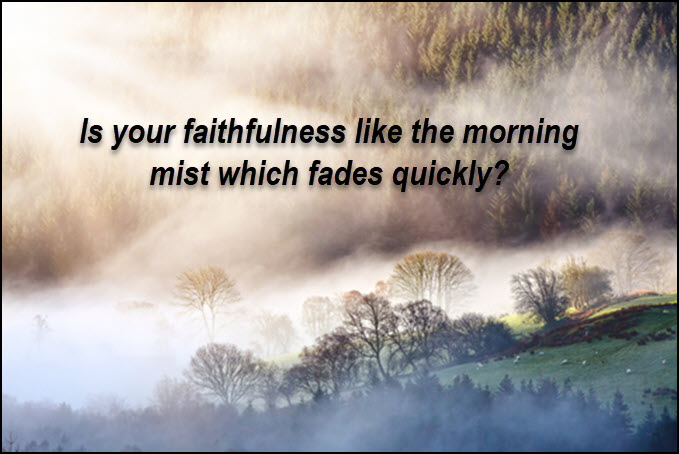
Faithfulness: like a morning mist or like the noonday sun?

Hosea 5 to 7 Hosea reminds the Israelites that God sees their unfaithfulness just like the morning mist which disappears with the sun. He reminded them that instead of seeking God they sought Assyria.  Their sacrifices lay upon the altars but are not consumed because of their broken relationship.  God is calling them, and us, to delight in Him alone!  He delights in our faithfulness to Him that He might sanctify us. He is not interested in sacrifices. Instead He delights in our acknowledgment of Him.

The world is saying: God is archaic! God’s words do not bring hope!  Hebrews reminds us that because God is omniscient we should be careful not to “be carried away by all sorts of strange teachings.” Instead, cling to this truth: “Jesus Christ is the same yesterday and today and forever.” [Heb 13] because even if “Heaven and earth pass away, His words will never pass away.” [Mark 13]

Beloved, where have you fallen for the mantra of the idols of wood, stone, and that which perishes?  God is saying I delight in faithfulness, not simply sacrifice. God says “return to me, and I will return to you.” [Mal 3]

Optimized by Optimole