I Won’t!

Will you obey

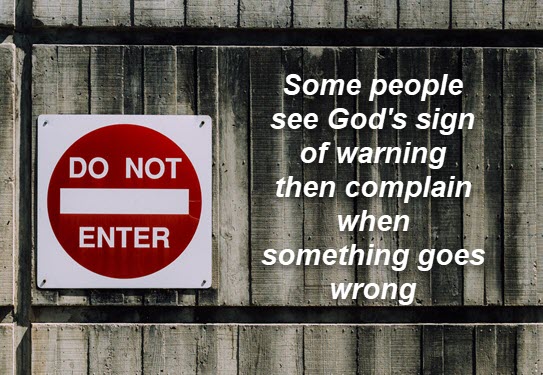
Jeremiah 43: There is a phrase that says: “There is a sucker born every minute.” It seems that in Jeremiah’s day that statement was more than true. Having seen the devastation of the land, the temple, and the carrying off of prisoners, the ones left still did not trust their faithful prophet, Jeremiah. Over and over he had said to yield to their captors, trust God and you will live but they would not. And so we see that the fools decided the words of Jeremiah were untrue, packed up and went to Egypt, and sure enough, trouble followed them. They never returned to Israel, just as God said. They were of the Dennis the Menace generation. I am sitting down on the outside but standing up on the inside. I refuse to admit I am wrong, I refuse to obey, yet are the first to complain when trouble comes their way. 

Today the gospel is free but many refuse to listen and submit to God’s ways. They still think that their works are better than God’s ways. Clearly, as Paul wrote: “For by grace you have been saved through faith. And this is not your own doing; it is the gift of God, not a result of works, so that no one may boast.” [Eph 2:8-9]


How Then Shall We Live?

Living by Faith

Habakkuk 1 – 3 The headlines scream as the government fails. Where are the spiritual leaders? They were hiding then, as many are today. Habakkuk sees an encroaching army and asks God why He is allowing this; weren’t the Israelites His people? God responds as He has in the past: renounce your sin and turn from your wickedness, and I will restore. 

Why do we have to see this? Why does God allow a wicked nation to come? Where are the protectors? God then answers Habakkuk with a visual word picture about these villains. They mock the righteous. They scorn anyone who speaks with a righteous tongue. And like him, we ask: “Why do you say nothing when the wicked devour those more righteous than they are?”  [Hab 1:13] God reminds Habakkuk and us that one day these will stand in His judgment and be found wanting. 

What is the lesson we are to take from this book? It is the same for us as it was  then: “the righteous will live by faith.” Secondly, like Habakkuk  say: “I will rejoice because of the Lord.” Where are we rejoicing instead of whining? Where are we watching on the wall for His word? Where are we faithful?

Habakkuk pleads with God in prayer: “But when you cause turmoil, remember to show us mercy!” [Hab 3:2] Is this our prayer?

“Search the Scriptures”

Search the scriptures

2Kings 2-25, 2Chron36 No matter where we read, we see that over and over, God was gracious to send His messengers to the people so that they would know what He required. How did they respond? They mocked the messengers, despised his Word, and scoffed until the wrath of the Lord arose against His people until there was no remedy. There is a saying; learn from the past so you don’t have to repeat it.


How do we respond to the messengers God has sent?  Are we gleaning one truth each day from our reading and then applying that to our life? Prov 3:5-6 tells us to trust in the Lord with all our heart, lean not on our own understanding, acknowledge God in all our ways, and He will make our paths straight.

How are we responding to the Word of God? We can only respond if we are “in the Word” daily. Are we reading to glean a truth to guide us today?

The Israelites refused and ended up in captivity. May we learn from them what not to do and what to do.

Are you an Interceder?

God has planned for us to intercede

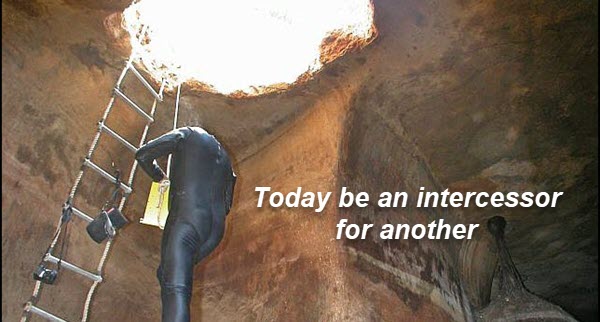
Jeremiah 38 As often as we read stories like this, we get caught up in the excitement and danger of the storyline, we call it a “cliff hanger” and we wait for the savior to rescue the one in danger. Those are fiction, but this is real and we see that in the midst of danger, God always has a “man of the hour” ready to step in. God may not call us to confront a king or a president regarding the plight of another, but He may call us to serve through intercession. Ebed-Melech had the heart to serve no matter the cost. He was willing to step in and confront the vacillating cowardly king Zedekiah. Over and over through scripture, we see how God orchestrates events and places people in places to serve His chosen ones.

In Genesis, we read about Joseph being placed unjustly in prison, just like Jeremiah. There, an unlikely series of events brought Joseph face to face with Pharaoh’s servant, who had a dream that he interpreted.  The cupbearer promised to speak to Pharaoh, but it would be two more years before he remembered. Because God used the cupbearer, Joseph was released and elevated. Because Ebed-Melech was God’s servant, he was willing to be the man of the hour to step in and save Jeremiah from certain death.

Has God placed you in a position to save another? We have the gospel message to save men from sin; are we sharing it? Have you stepped up to the plate, or are you like the cupbearer who failed to remember his promise?

“Faithfulness vs Unfaithfulness”

God rewards faith and curses unfaith

Jeremiah 35 to 37 Joshua challenged the men of Israel many years ago before these chapters: “Choose ye this day whom you will serve, but for me and my house we will serve the Lord.” [Josh 24:15]. It would have been wise for the men of Judah to have remembered these words because God had placed a similar challenge before them again. Jeremiah puts three stories before us to show us the rewards of faithfulness vs. the consequences of unfaithfulness.

The Rechabites, a nomadic tribe, were faithful to their ancestors never to drink wine and remain nomads. Even as Jeremiah tested them, they remained steadfast, and God gave them a blessing. “Jonadab the son of Rechab shall not lack a man to stand before Me always.” [Jer 35:19]

In sharp contrast to the Rechabites is King Jehoiakim, who “did not rend his garments” nor humble himself but burned the scroll of God’s words. To him came this pronouncement: “He shall have no one to sit on the throne of David…I will also punish him and his descendants and his servants for their iniquity,” [Jer 36:30-31]

The third story Jeremiah is about King Zedekiah, who was a vacillating king. Although fearful, he would not trust the words of Jeremiah about the impending overthrow of Jerusalem by King Nebuchadnezzar. However, he would later see that what God had said would come true. [Jer 39]

What is the lesson God wants us to learn?

God rewards faithfulness and removes blessing from the unfaithful. Where are you?  

Sealed until the day of Redemption

you are sealed

Jeremiah 32 Sealed Until The Day of Redemption

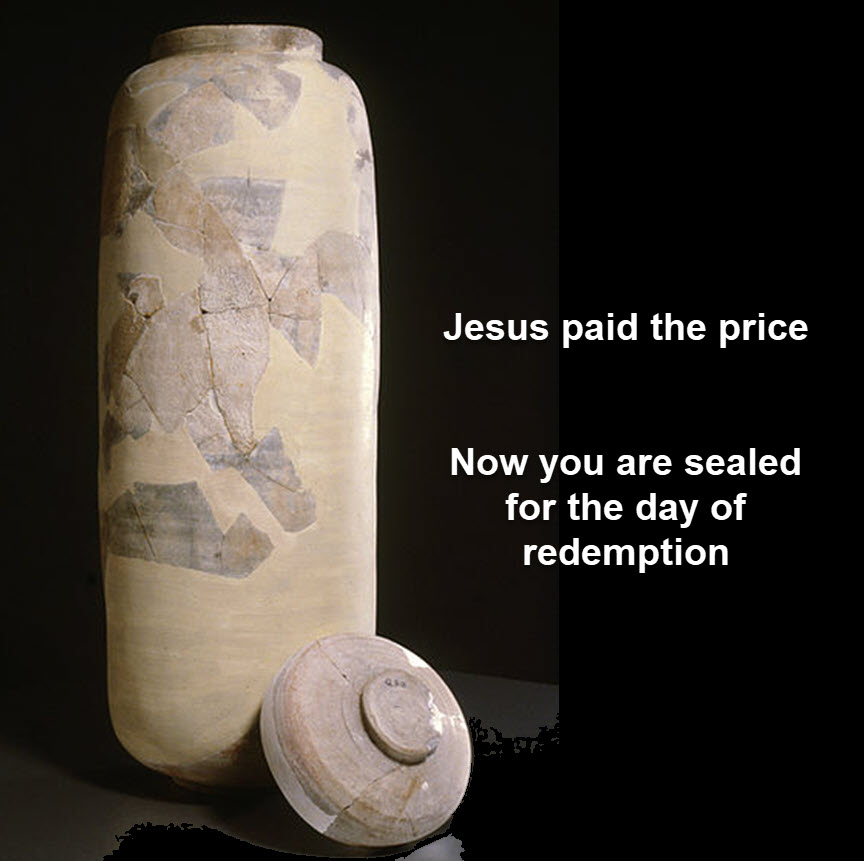
Hanamel, Jeremiah’s cousin, came to request that he purchase his land. Jeremiah had the right of redemption, and he was the next of kin. He was the kinsman-redeemer for Hanamel, just as Boaz was the kinsman-redeemer for Naomi and Ruth. The pattern was the same; a request is made, a deed is drawn up, witnesses are there to watch the transaction. Jeremiah paid the redemption price in silver; Jesus paid the redemption price in his blood.

God’s plan was to restore the land and restore the people from their captivity. Jesus came to restore us from our captivity of sin. The principle is the same for us as for the Israelites: “For I know the plans that I have for you,’ declares the LORD, ‘plans for welfare and not for calamity to give you a future and a hope.” [Jer 29:11]

The pattern is repeated from Ruth to Jeremiah to Jesus in the NT. Is Jesus your kinsman-redeemer? Have you been bought with a price? If not, know this truth: He is waiting with pen in hand to sign the document of release to redeem you from your sin. Just as Jeremiah sealed the document in the earthenware jar, “you are then sealed for the day of redemption.” [Eph 4:30]

God the Master Pruner

God prunes us

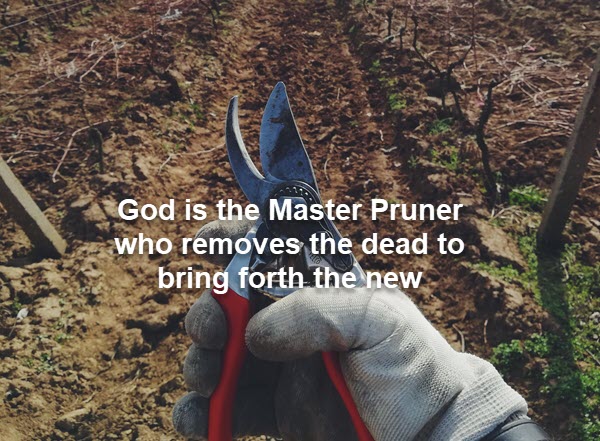
Jeremiah er 27 God the Master Pruner. As a gardener, one learns sooner or later, pruning does not hurt but helps the plant. Removing the dead growth gives room for the new growth to occur, and the newest is stronger. The dead is weak and takes nourishment from the plant. Jeremiah reminds Israel that they are the vine that God chose, but it needs pruning, and He places his pruning shears in the hand of King Nebuchadnezzar of Babylon. Jeremiah tells the people of this impending pruning, but they refuse to listen and instead want to “prune” Jeremiah by cutting him off. But, God is not only the Master Pruner, but He is the Master Protector and does just that for his prophet, Jeremiah.

Sometimes we can’t understand what God is doing, but God is in the business of pruning us so we might grow stronger. He often uses trials and challenging circumstances for that to happen.

Do we resist His pruning shears or allow their sharp cuts to take away the deadness?

How to be discerning

use scripture to discern

Jeremiah 23 “We dare not become lazy and expect others to do our studying and thinking for us.” [B. Deffinbaugh] As we listen to Jeremiah’s words, we hear the newscasts of today, which “demonize what is right and celebrate what is wrong.” Our culture wants God’s love apart from the price paid on the cross.  The people of Judah were uncomfortable with Jeremiah’s words of impending judgment for their sin. Jeremiah’s words fell upon deaf ears and sometimes landed him in stocks or a mud-filled cistern.

Jeremiah gave the people at least six ways to discern false prophets. We can learn from his words.

Observe and listen carefully. Do their words line up with God’s Word? Secondly, observe their lives and ask if they are consistent? Are they honoring God in word and deed? Thirdly, are they presenting false hopes? These countered Jeremiah’s words of judgment with ‘nothing bad will happen to you.’ Fifthly, they were in a hurry to deliver their message. Sixthly they claimed to hear God speaking, but if they had been in God’s inner circle; they would have heard the exact same words of impending Babylonian judgment due to their disobedience.

Fast forward to today. There are sheep in wolves’ clothing amongst us. We must also discern their character. Listen and look; observe their fruits; listen to the doctrine they teach.

Jeremiah’s Alexander Day

Jeremiahs' Day reflection

Jeremiah 20: Have you ever had one of “those” days when nothing goes right? There is a story about a boy named Alexander whose life seems like that. His day begins with gum getting stuck in his hair, and the rest of his day is all downhill. It really is one of those “Terrible, Horrible, No Good Days.” Jeremiah is having just such a day, to put it bluntly. God has called him to preach to a people who just will not listen. Like the men in the depression who wore storyboards to announce something and people walked by ignoring them or making remarks better left unsaid, Jeremiah takes his storyboard of God’s message to the passers-by and has the same reaction. Yes, it is one of Jeremiah’s “Terrible, Horrible, No Good, Very Bad Days.” 

His day ended with sitting in the stocks in the city square, thanks to the Priest Pashur which he used to make Jeremiah a laughing stock. Jeremiah has come to the end and shouts to God: ‘I QUIT!” Can you relate? God listens but does not comment. Yes, God is silent just when we need to vent. But then, in the quiet, Jeremiah stops and begins to tell God:

Your message is like a fire burning within me. I am tired, God. I want to quit God. But, then a still quiet voice says; keep on keeping on. I hear, and I note, and I have a blessing for you—so “hangest thou in there.” 

So when you are having an Alexander Day, stop and talk to God, and like then just like Ezekiel, listen for His quiet voice.

Mirror, mirror, what do you see?

The mirror only sees the outside

Jeremiah 17: As Christians, the ones who have chosen “the Way,” we often are reminded about the deceitfulness of our hearts. Indeed, as Jeremiah reflects, our hearts are known by God. But the world system comes alongside and seeks to hide our sin from us which never will be hidden from the eyes of God. We say, but we do not do. We are like the man from James who looks into the mirror and then walks away, forgetting what he has seen. [James 1:23-24] Ray Stedman once wrote: “Do we cling to the myth of our own perfectibility, or do we reckon our old self crucified with Christ…?” That is the real question before us this day. Paul reflected on this in the letter to the Galatians: “For if anyone thinks he is something when he is nothing, he deceives himself.” [Gal 6:3]

Jeremiah speaks to the man observing himself. Listen, Beloved, the man in the mirror is each one of us, and the mirror never lies. Yet, a mirror only sees the outside, but God sees the inner man. The inner man’s heart is deceitful and desperately wicked, and God not only sees it but knows it. [Jer 17:9-10]To change, we must immerse ourselves in the Word daily. Then as Jeremiah and the Psalmist say, we will be like a tree planted by the streams of water, which spreads its roots, and the leaf will be green nor ceases producing fruit. [Jer 17:7 & Ps 1]

What does your mirror reveal to God today?

Optimized by Optimole