Chosen by God

God so loved

Psalm 89 The Calling of David and You

God called the nation of Israel out of Egypt,not because they were more numerous or more wise or more strong.  God said He chose them “because of his love and his faithfulness to the promise he solemnly vowed to their ancestors that the Lord brought them out with great power, redeeming them from the place of slavery, from the power of Pharaoh king of Egypt.” [Deut 7:7-9]

In this psalm God’s call to David was similar: “I have made a covenant with my chosen one;I have made a promise on oath to David, my servant.” [Ps 89:3] It wasn’t because of his strength or riches or fame. He chose David, just as He has chosen you, because He looked down from heaven and found David and you as one who would be faithful. He chose you from the foundation of the world to be His servant. With this choice, God promised to love, protect and be faithful to you in all of your work and exploits. 

Reader, think on this: you were chosen! God found you and birthed you to be a part of His kingdom. Jesus said “You did not choose me, but I chose you and appointed you to go and bear fruit, fruit that remains, [Jn 15:16]

“I Have Plenty of Time”

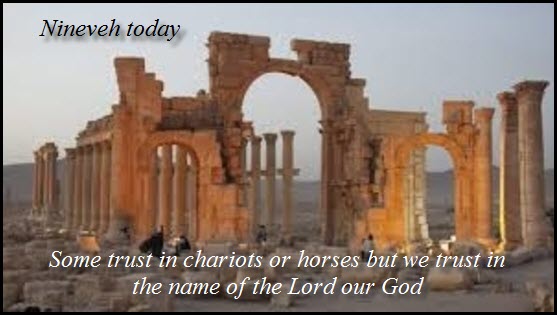
nineveh-today2-resized2a

Nahum 2: Eternity is Just Around the Corner

Our world is consumed with “fluff” meaning that which is without substance. It wants what “feels good.”  The city of Nineveh was like that; trusting in its captured riches at the expense of others. Like Nineveh, today when we speak to others of the goodness, holiness and sure justice of God they answer “What? Me Worry?” about eternity? I have plenty of time.

Learn the lesson of the man who built his barns; sat back and said; “You have plenty of goods stored up for many years; relax, eat, drink, celebrate.” But God said “you fool, this very night your life will be demanded back from  you…” [Luke 12] That was the mindset of Nineveh. God gave Nahum a message of both hope for the Judahites whose riches had been plundered by them and a message of imminent destruction for Nineveh. They had had 100+ years of blessing from God’s decree of judgment but like so many today said–tomorrow I will worry about eternity.

God is slow to anger, abounding in lovingkindness but he is also “a zealous and avenging God.” He also “will certainly not allow the wicked to go unpunished.” God loved Judah; God loved Nineveh and God loves you. He may allow the storm to continue but one day the storm will pass and the sun will shine forth. God will bring an end to suffering and He will make all wrongs right again.

The Ninevites trusted in their walls but it was washed away in a single night. What do you trust in?

“Some trust in chariots and others in horsesbut we trust in the Lord our God.” [Psa 20]

Psalm 19-20 “God in all of His Glory!”

psalm 19 god and his glory revealedaDr. Henry Morris in reflecting on this psalm wrote: “The 19th psalm is one of the most magnificent writings in the Bible and indeed in all literature. Charles Spurgeon also in reflecting wrote: “Any book without its first page would be sadly imperfect, and especially the great Natural Bible, since its first pages, the sun, moon, and stars, supply light to the rest of the volume, and are thus the keys, without which the writing which follows would be dark and undiscerned

So from a scientist to a theologian we have the same view: God is sovereign and He is revealed in the glorious expanse of the heavens. Thus the words of Paul resonate with our spirits: “For since the creation of the world his invisible attributes – his eternal power and divine nature – have been clearly seen, because they are understood through what has been made” We see them as we stand and view the heavens in the dark of night or the bright light of day. No matter when, God has clearly revealed himself that we may bow our knee in humble adoration and praise him for who he is and for his glorious majesty.

Psalm 108 “When Morning Gilds the Skies”

ImageWhat was your morning like today? Did you wake up chipper and raring to go or dragging? How do you begin your day, with or without a time alone with God? King David was both a morning person and also a night owl. Although busy with kingdom issues, David found time to be alone with God in reading and in prayer. God was his priority no matter the kingdom or family issues before him. We would be wise to learn from him how to juggle our thoughts and our time.

Ps 108 begins with this thought: my heart is fixed or steadfast, my heart is confident or as the MSG puts it “I’m ready, God, so ready from head to toe.” When we begin our time alone with God can we say we are ready to hear from him or are our minds so saturated with the busyness before us that we find it hard to focus?

David continues on to share how he gets ready to be with God; he sings and praises God with all of his heart. This alerts our mind to focus in on who God is and prepares us to listen to him. What song comes to mind when you think of praising Him? Here’s one of old:

                   When morning gilds the skies

                   my heart awakening cries: 

                   May Jesus Christ be praised! 

                   Alike at work and prayer,

                   to Jesus I repair: 

                  May Jesus Christ be praised!

In vs 2 David says awake, O stringed instrument and harp. Long ago often they would place their stringed instruments near to their place of sleep much like you place your alarm clock by your bed. But instead of that buzz, buzz, buzz, they would hear the breezes flowing and touching the strings which would cause the strings to vibrate and awaken them with beautiful music. What a beautiful picture of how God’s gentleness touches us.

Once awake David, as he did in Ps 57:7-11 and Ps 60: 5-12 (repetition of this psalm), began to give praises to God for his lovingkindness and his faithfulness. He is overwhelmed by the thought that God is so great that these two attributes extend beyond the sky. God is limitless as are his attributes; they span the universe that even we cannot see or fathom.

As you ponder who God is and think ahead, why not make a date with God for your time alone with him  in the wee hours of the morning and let His breezes awaken you to His soft voice proclaiming His lovingkindness and faithfulness. What a marvelous tool to start our day!

Soar Like the Eagle!

ImageA good question to ask oneself might be: Where am I today in my spiritual walk? Have I stopped to thank God for His many provisions of blessings?

 In Psalm 102 we find that the psalmist is “in the pits.”  The psalmist  visualizes life alone, life without hope. “I am like an owl in the wilderness;”  bereft of friendship and like a ruin that has been abandoned;  like the solitary bird on a rooftop, alone and separated from company.  In sharp contrast, in Psalm 103 he is soaring like the eagle, the bird that commands the heavens with its ability to fly to the heights of the clouds and descend with a crescendo to capture its prey, in control over others. C.H. Spurgeon wrote: Renewal of strength, amounting to a grant of a new lease of life, was granted to the Psalmist; he was so restored to his former self that he grew young again, and looked as vigorous as an eagle, whose eye can gaze upon the sun, and whose wing can mount above the storm. It is in this time that the psalmist reflects how blessed he has become because of the Lord’s provision and protection.

In reading this psalm reflect on the word “all” and count the many ways that God has touched your life. As a pastor and poet, H. F. Lyte did just that and wrote a famous hymn “Praise, My Soul, The King of Heaven.” The first stanza sums up his thoughts as he reflected in his time of prayer and praise:

 Praise, my soul, the King of Heaven;
To His feet thy tribute bring.
Ransomed, healed, restored, forgiven,
Evermore His praises sing:
Alleluia! Alleluia!
Praise the everlasting King.

Take time today and ponder the many blessings that God has placed before you. “God’s blessings… include forgiveness of sins, healing from sickness, deliverance from death, enrichment of life, satisfaction, and rejuvenation.” [Constable].

Ponder the eagle as a picture of rejuvenation. The eagle mates for life, builds his nest at the very tops of trees, remains strong and lives the longest of any bird, often to 38 yrs. The eagle remains vigorous, symbolizing power, freedom and transcendence, meaning that they surpass and exceed in superiority to the end of their lives. “Likewise God enables His people to remain spiritually vigorous until death.” [Constable]

Where are you today in your spiritual walk? Stop and meditate upon this psalm today and be renewed like the eagle.

 

How Do You Worship?

ImageOne of the greatest compliments ever paid to Christianity in the first century is that believers’ lives were so changed from the inside out that they turned the world upside down. Is that what the world says about us or do we fade into the background? If ever there were two psalms that should ignite our passion it is Psalm 95 and 96 which mirror Romans 1:20. God’s very creation sings for joy and we should be as well.

As you read these two psalms note the imperative verbs: Come! Shout! Sing! Bow Down and Worship! Proclaim! Tell! Ascribe! Say! Kneel! Announce every day! How can a Christian be silent when we read words such as these? As you enter the sanctuary open your hearts to worship and let the Illuminating Holy Spirit enter and change you from the inside out. Go forth and proclaim to those about that you are a new creature in Christ…and do it TODAY for Psalm 95 implores that.

Who is the Lord Most High? He is majestic in His splendor, note that the psalmist used that word three times in vs. 6,7,8. What does that mean to you? Spend some time pondering that you are entering the Holy of Holies. Dress in holy attire for you come to stand in the presence of the King of Kings.

Image

It is Fitting…and no this is not about clothes!

ImageHow fitting to follow Romans 11 with  Psalm 92 and 93  which teach us much about humility, about the Creator, the Sovereign One in all of His fullness, and His work. The psalmist says it is fitting (it is a beautiful thing, it is a good thing) that we should give thanks to the Lord Most High! Stop and give Him praise today for Vs. 5 He works are great, His thoughts are deep; Vs. 8 He reigns forever; VS. 10 He has chosen to exalt the righteous and anointed us; Vs. 12 He promises that the  righteous will flourish; and Vs. 14 He promises as the palm continue to be fruitful even in old age. How marvelous is our God!

As the psalmist walked about and observed the workings of the Temple and the Palace of the King he came away with a picture of God’s provision for those He has blessed. The cedar is mentioned 51 times as Cedar and 24 times as Cedars in the Bible. Because of its strength, longevity, its height, and its durability it was chosen for the building materials to construct the Temple. Its walls were lined with cedar, on which were carved figures of cherubim, palm-trees, and open flowers, which were overlaid with gold. (Wikipedia)

ImageThe palm also is a picture of longevity and in fact continues to provide fruit even when old, is continually filled with vitality with  many leaves. In the cedar built courtyard, the palm provided shade in the heat. Sequestered in the court it was protected against the desert storms and fluctuating temperatures and it is here that it was nourished and protected.

Both of these trees give us a beautiful picture of the righteous who has chosen to dwell in the courts of God. Psa 84:10 “Certainly spending just one day in your temple courts is better than spending a thousand elsewhere.” Psa 65:4 “How blessed is the one whom you choose, and allow to live in your palace courtsImage

We thank thee Our Father for these beautiful pictures of the righteous. May we give you thanks and praise! You truly are the Lord Most High…and thus it is fitting, right, correct, and my duty to praise Thee!

Rom 11:36 For from him and through him and to him are all things. To him be glory forever! Amen.

Revenge or Forgiveness ..Your Choice

ImagePsalm 69 is one of the three most quoted psalms in the NT in reference to “The Messiah.”  (e.g. Those who hate me without cause [Jn 15:25], vinegar to drink [Matt 17:48]. Thus it is fitting that we walk through this psalm as part of our study in the book of Matthew about our True Messiah. This psalm and the life of Christ will teach us the two paths before us and our choices when we too face times of despair.  

David begins his psalm with an analogy of physical drowning using it to show God how he is coping with the enemies that are about him. David compares his drowning to Jeremiah or Joseph in a pit with no way out. In vs 5 to 12 we feel his pang of loneliness and as we read the story of Joseph we recall the brothers as they stood before Joseph: “we saw how distressed he was when he cried to us for mercy, but we refused to listen.”

In vs 13 to 15 we see a change in David’s tone as he reminds himself of God’s lovingkindness and compassion, his saving truth, the fact that he alone is one’s redeemer. But even as he recalls this he also seeks revenge for what these enemies of his soul have done. From David: [vs 24-28] from God upon his enemies [pour out your judgment upon them, do not vindicate them, may their names be deleted from the scroll of the living].  In contrast to David’s outburst we move to the NT and see the higher way to seek justice. Jesus becomes our example as on the cross he cried out “Father forgive them for they know not what they do.” [Luke 23:34]

Today may we choose the higher path, the path of our Savior, our True Messiah.

Optimized by Optimole