Rejection and Decisions

1Sam 13-14 How do we handle rejection? The people rejected Samuel in favor of a king. God reminded him that they were not rejecting him but God Himself. That is a powerful lesson for us to remember when we, too, face rejection. Samuel’s humble character is revealed in how he faced this. He went to God, not other people. What do I do when rejected? Do I turn to God and lay this burden before Him, or do I wallow in my self-imposed pity party? May I learn from Samuel that when rejected, handle it with humility.

Saul is chosen king, but he is a faithless king. He is ensnared by his fear of people rather than God. [Prov 29:25] He makes foolish vows which cause the people to be faint, which happens when God is not consulted. He who makes foolish vows will ultimately pay the price as King Saul did. Be wise and discerning when considering a vow because it is usually hypocritical and because of pride. “OUCH!”

Lessons for us from these passages: Remain humble when rejected and understand that God is rejected more so than us. Secondly, consult God before making decisions that will affect others.

Choices

1 Sam 9-12
The people reject Samuel’s sons, and rightly so, for they were not men ‘of the cloth’ but of perversion. We wonder why Samuel chose to make them judges when not one before him did so. The fruit is in the pudding, so to speak. They were unwise, and the people perceived that these men would be their leaders if Samuel died. Using their natural rather than spiritual eyes, they didn’t ask God for His direction. Instead, they wanted to be like the nations around them. How foolish! Had they really looked at what takes place when a king is over them? They take, and they take, and they take and do not give. How often do we fail to observe the consequences of others’ choices and see that as a lesson for what lies ahead for us?

Father, give us the spiritual wisdom to choose Your way and Your man to lead us.

The prayers of the Righteous

1Sam 1-3 The book of Ruth ushered us into the realm of the righteous by one who decided to follow God based upon the witness and life of her in-laws, especially her righteous mother-in-law Naomi. Was it her life or her prayers that spoke to Ruth’s heart? We don’t know, but we do know that Ruth willingly forsook her homeland and the idols of Moab to encounter the Lord of Hosts, Yahweh.

Fast forward to 1 Samuel, where we meet another righteous woman, Hannah. She is the epitome of the words of James: “The prayer of a righteous person has great effectiveness.” [James 5:16] She is an example to us when we face criticism for our prayer walk. God blessed her and gave her the desire of her heart in the birth of Samuel and then, beyond that, more children.

Today determine to be a prayer warrior!

God is Way Maker, Promise Keeper…

Ruth 1-4 Light in the Darkness

This is a new chorus that resonates in my mind: You are Way maker, miracle worker, promise keeper, Light in the darkness, My God, that is who You are You are…

Do we trust God in the hardest of times, or do we follow the example of Abraham and Elimelech in a time of famine? Both moved to places that lived, breathed, and worshiped wood and stone idols. But, what man does is not a hindrance to God who is at work that we might know the truth of Isaiah 55:8-9, “my ways are higher than yours.”

In Judges, the people ignored and rebelled against God, and every man did what was right in his own heart. Yet God reminds us that He is God. As the director of our steps, He is busy orchestrating circumstances to prove that He is a promise keeper so that we might recognize His plan.

Far away from Israel, we find that Elimelech and his two sons pass away, and Naomi is left destitute. How often in our most desperate states does God intervene to teach us He is not only a promise keeper but a God of provision? We are His workmanship that He has prepared beforehand so we can be a part of His plan. [Eph 2:10]Here in this godforsaken land, God will use one gentle, kind, widowed daughter-in-law, Ruth, so that bereaved Naomi will be comforted. Ruth’s words echo across the centuries: “your God will be my God.” Do I say that as well?

Where is God your way maker, promise keeper, light in your darkness today?

Pray for Discernment

Judges 1:14-15 and Judges 19-21 Hypocrisy in Living Color

We remember that the author of Judges opened his diary to show us the ugliness of sin and the contrast between purity and righteousness. Thankfully, the author of Judges reminds us that not all men are like this horrid Levite who cares so little for his concubine that he is willing to throw her to the wolves. He did not care about her spiritually or physically. But God shows at the beginning of Judges that not all men are like him. There are some righteous men in this world, and Caleb is one of those knights in shining armor. He loved his daughter Achsah and provided a husband, land, and then springs of water. He is the antithesis of this Levite. Unfortunately, there are such men as this Levite, who are despicable. There are not enough words to describe his way of life. He was a fraud and hypocrite in the truest sense. Levites were to be the spiritual leaders of Israel, but this Levite had no spiritual longings for God or His word or His people.

Beware of frauds and hypocrites like this Levite. Pray for discernment and wisdom to unearth the true qualities of a person. Pray for your girls to be discerning and for your young men to be righteous. Then put your tears in the bottles that God protects: Psa 126:5 Those who shed tears as they plant will shout for joy when they reap the harvest.

How to “Not” Honor God

Judges 17: When God is absent from men’s hearts, pursuing God’s kingdom and His righteousness takes a back seat. Meet Micah, whose name means “who is like God,” an example. He lived just a stone’s throw from the tent of God in Shiloh but lived by this principle: What is mine is mine, and what is yours is mine as well. God had said, “Thou shalt not steal” [Ex 20:15], but for Micah, stealing was just another day in his life.  Further, when he stole, his own mother blessed him by having an idol made to honor his treachery! 🙁 Then, one day, a wandering Levite from Bethlehem comes looking for a place to stay, and Micah bribed him with ten pieces of silver per year to be his priest. However, that loyalty only lasted until a better offer came along.

This story, along with Samson’s, teaches us the principles of Romans 1:18 they suppress the truth by their unrighteousness. God’s presence is near, but it is unimportant. They claim to be wise but instead become a fool. [Rom 1:22] And so God gives them over to a depraved mind.

Want to honor God? Choose ye this day whom you will serve [Josh 24:15] and be ye holy as God is holy. [1Peter 1:16 ]

A Crisis of Belief

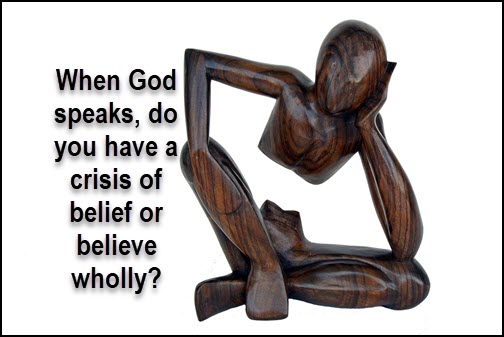
When God speaks, do you have a crisis of belief

Judges 13-15 Back in the day of the Judges, the Israelites were excited when a baby was coming, but for some, like Mrs. Manoah, there was only sadness because she was barren. Was she sitting out in the field bemoaning her plight? Did God look down from heaven and say that there is a godly woman who needs a child? God knows the heart of women; men too, but this story is about a woman:

Whatever the circumstances were, she was out in the field, and Mr. Manoah was “house sitting.” What was he doing? Watching the sports channel? Anyway, he missed the blessing, but she was granted an audience with the Angel of the Lord.

Is there a time I miss the blessing because I am in the wrong place at the wrong time?

Enter God’s grace and patience. The Angel of the Lord appears again, and this time both parents-to-be are granted God’s vision and blessing. Excitedly, Mr. Manoah prepares a feast, and the Angel tells him to expect a child soon. Then unexpectedly, the Angel disappears, and Mr. Manoah has a “crisis of belief.” 🙁 “We will certainly die because we have seen a supernatural being.” In light of all that has happened, Mrs. Manoah gathers up her skirts, looks him in the eye, and says: LOOK! If the Lord wanted to kill us, don’t you think he would have done it then? “rolling eyes here”

You know God has a way of sharing his blessings, but we must be prepared and believe God when they come.

The Patience of God

Judges 10 There is a pattern that becomes very evident in this book, and it is what we read in Judges 10:10 “The Israelites cried out for help to the Lord: “We have sinned against you. We abandoned our God and worshiped the Baals.” How many times does a nation have to walk the same route to get the message that God is God and He will not share his glory with another? And yet: “When the righteous cry for help, the Lord hears and delivers them out of all their troubles. “ [Ps 34:17]

Judges 9-12 reveals that, once again, the nation started out correctly but soon diminished into chaos and idolatry. It is then that they come back to God in tears and repentance. When the judge died, and the people are left without a godly leader they revert back to idolatry. The patience of God is remarkable; He allows us to wallow in the mire but is ready to forgive and reinstate us to a higher state. God has placed these chapters here for a reason so that we might learn and apply biblical principles to our lives.

What lessons is God teaching you as you read this book?

Start and finish strong…give God the glory

Judges 5-8 God is gracious to show us through the story of Gideon that we face two enemies: fear and pride. [Prov. 29:25]. In the story of Gideon, we see how Gideon’s fear of enemies led him to compromise and drew him away from giving God the glory. Yet, God was gracious and told him to sneak into the enemy’s camp, where he heard: The Sword of the Lord and Gideon. Still, after the battle, instead of reminding the other tribes that God was the Victor, he collects gold to make an ephod which became a snare to the nation and his family.

Sin is ugly! Pride is ugly! 

Do we forget this part of the story and only tell of the victory? There is a lesson here for us and our children. When God is gracious to lead us to victory, don’t take that glory to ourselves. God is jealous, and He will not share His glory with another. [Is. 42:8]

We must determine to finish strong and give God the glory. He who humbles himself, God will exalt, [Luke 14:11] and the contrast is also true.

Are we trying to hide from God?

fear is a snare

Judges 6-7 Why is it that we think we must be the strongest, bravest, and wisest for God to use us? We are not all Braveheart; some are like Monk, the fearful detective. Solomon understood this: Ecc 9:11 Again, I observed this on the earth: The race is not always won by the swiftest, the battle is not always won by the strongest; prosperity does not always belong to those who are the wisest; wealth does not always belong to those who are the most discerning, nor does success always come to those with the most knowledge—for time and chance may overcome them all.

Gideon came from the smallest clan, and he was just like Monk, exceedingly fearful. He was so afraid that when the Angel of the Lord found him, he was hiding in the winepress so the Midianites wouldn’t find him. How like us. We often find ourselves hiding so God “can’t” find us. But nothing is hidden from the eyes of God, and He wanted to prove a point, and that point was; you don’t need to be the bravest, strongest, or most wise. You just need to be available. True, Gideon wanted a sign, but ultimately, he led the nation to a victory over their enemies.

Where are we hiding? Will we allow the Angel of the Lord to find us?

Optimized by Optimole