From Angst to Peace

Jesus paid it all

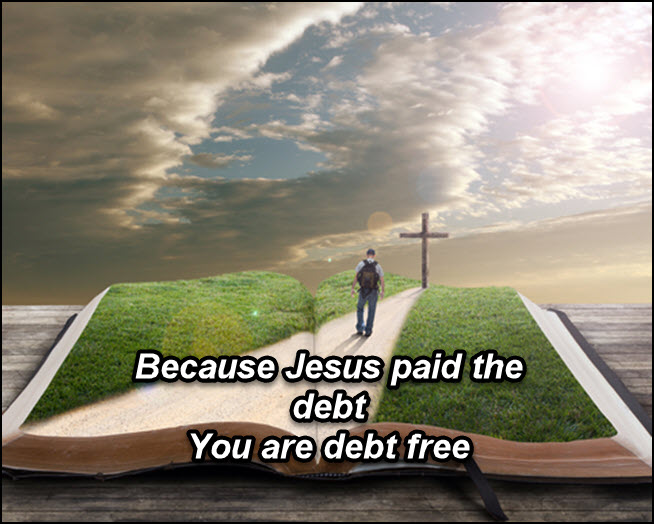
Psalm 50 and 51 Our world is in deep trouble, yet the world says it will give you peace and security. The world lies, and if we love the world, we are not of God. [1John] Instead, we are worshiping the creation more than the Creator.[Rom 1] Jesus, God’s Son, has paid our debt and even though the world is striving to do the right “thing,” it lacks the one thing He desires: a humble spirit and a repentant heart. Without the sacrifice of our Savior, we remain indebted. But, thanks be to God that Jesus paid our sin debt.

In the OT, people brought animal sacrifices to the Tabernacle/Temple, and the High Priest would acknowledge such and pray for the individual. As temporary forgiveness, it had to be repeated over and over. On the cross, Jesus said, “it is finished,” and the veil in the temple was rent in two from top to bottom, opening the way to God. Now we can confidently approach the throne of grace to receive mercy and find grace. [Heb 4:16]Today we offer our bodies, alive, holy, and pleasing to Him, which is our reasonable service for all He has done. [Rom 12:1].

Are you still walking around with the sin label, or are you set free?

How to Handle God’s “no’s”

What do you do when God says no?

2Sam 7 & 1Chron 17 What do you do in the quiet of the moment? There is a lull now in the fighting due to the absence of Saul and his sons and David has conquered Jerusalem, making it his home. Like many of us, he sees his life passing before his eyes and realizes that although God has prospered him, he has an inner desire to do more–not for himself–but God before his days come to an end. Thus, in a time of peace, David began to see how the Tabernacle could become a permanent structure. God was pleased with David’s desire but did not allow David to build Him a permanent structure, for he was a man of war. “But God said unto me, Thou shalt not build a house for my name, because thou hast been a man of war, and hast shed blood.” [1Chr 28:3]

Even when God said no, God used Nathan to bring a message of hope to him. Your line will continue and prosper and not end as it did with Saul’s. David was overwhelmed and went and sat before the Lord to pray. Is that our attitude of humility? He is an example of how we are to respond when God says no.

How often do we cry out to the Lord; why not Lord? Or do we go in and sit before the Lord and just gaze into His eyes and yield ourselves totally to His will with a grateful heart?

Focused on Praising God

Praising God Psalm 89

Psalm 89 Psalm 23, the Doxology and the Apostles creed were part of the liturgy in the churches not too long ago as a way of focusing the parishioners toward God.

Praise God, from Whom all blessings flow;
Praise Him, all creatures here below;
Praise Him above, ye heav’nly host;
Praise Father, Son, and Holy Ghost.

Ethan the Ezrahite was focused. He said he would sing continually about the Lord’s faithful deeds, and he would share those thoughts with future generations. Think about that! Centuries ago, Ezra wrote, and today we read his words of exaltation to God in word and song. “The heavens also praise his amazing deeds as well your faithfulness in the angelic assembly.” [Ps 89:5] At the birth of our Savior, the vast, heavenly army appeared with the angels, praising God.  We don’t need to be an angel to glorify God. Enjoy Ezra’s thoughts and claim them as your own, for his words of praise can be yours as well.  Ezra reminds us that if the angelic assembly takes time to praise God, we should do that as well.  Job referenced this same thought: When the morning stars sang in chorus and all the sons of God shouted for joy. [Job 38:7]

Habakkuk reminded himself that “though the fig tree does not bud…and the fields produce no food…yet I will rejoice in the Lord.” [Hab 3:17-18] In Paul’s day he reminded the Colossians, “exhort one another with all wisdom, singing psalms, hymns, and spiritual songs, all with grace in your hearts to God.” [Col 3:16]

Today spend time praising God for who He is and for what He has done! What is your favorite hymn or praise song that you sing to give God praise?

Are you the Wheat or the Chaff?

are you wheat or chaff

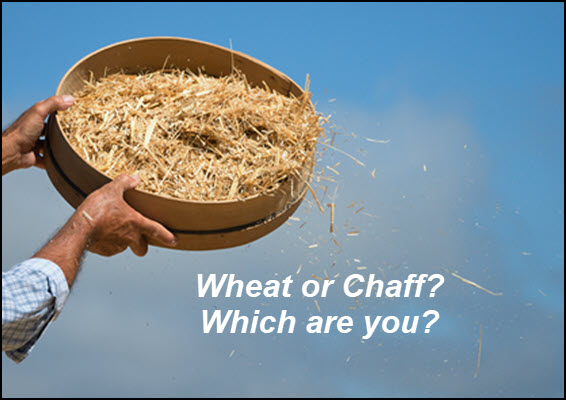
Psalms 1-2, 15, 22-24, 47 The Psalms: David as most likely the author of these psalms, reflects on the godly and the ungodly character in view of how God sees them. David contrasts the godly vs. the ungodly using an illustration from farming. The godly are busy with God’s work, and while he works, he ponders the words of God. The ungodly are like the chaff that the wind drives away.

 “Chaff is the loose, outer covering on wheat and other grains that must be separated in the threshing and winnowing process of harvesting grain. In Bible times, grain was threshed, trampled, crushed, and beaten on the outdoor threshing floor to separate the inedible parts of the grain, called chaff. The lightweight chaff would blow away on the wind or sometimes was burned as fuel. In the winnowing process, the grain was then tossed into the air, allowing the wind to separate further any remaining bits of the husk from the wheat. These bits, called chaff, would be carried away in fine particles like dust.” [explanation from gotquestions.org]

The chaff blows away or is burned—what a graphic picture of the ungodly through the eyes of the psalmist. The question then is; are you the wheat or the chaff?

How To Do It The Right Way

God's Word will tell us

2Sam 5 & 1Chron 13-16 Where were the Levites when David decided to bring the ark into Jerusalem using a cart instead of following Moses’ instructions about bearing it on their shoulders? David wondered “How will the ark of the Lord ever come to me?” [2Sam 6:9] Then David remembered, “we did not ask Him about the proper way to carry it.” [1Chron 15:13] That is a reminder that when we fail to keep ourselves close to God’s Word, we cannot discern His way.  Perhaps that is why Paul later reminded Timothy that it is His word that will teach, reprove, correct and train us in righteousness. [2Tim 3:16]

Where have we neglected to stay close to God so we know His purposes, statutes, and commandments? John told his flock “The one who says “I have come to know God” and yet does not keep his commandments is a liar, and the truth is not in such a person.” [1John 2:4]

Today keep a short account with God and stay in His Word, so you hear and know this principle: Isa 30:21 “You will hear a word spoken behind you, saying, “This is the correct way, walk in it,” whether you are heading to the right or the left.”

You can’t hear or obey His Word unless you read it each day and obey what you read.

God’s Love is like a never-ending road

God's love is like a never ending road

Psalm 106 – 107  Today our world is crippled by the onslaught of the enemy’s separation tactics, a.k.a. divorce. Families are torn asunder when one or more of the parties drift apart. It seems that no solution appears adequate or pleasant. In some ways, that scenario happened between God and the Israelite nation when they refused to obey Him. If only we would remember this verse: “When you make a vow to God; pay what you owe.” Beloved, it is better that you should not vow and not pay.” [Eccl 5:4-5]   Even when God removed His blessings, their hearts remained hard. Yet, the character of God is this; his love is steadfast and immovable.

 When we read God’s Word, we come face to face with a holy God whose love is steadfast, and we are humbled, and then we recognize how unworthy we are. We are overwhelmed, and many of us ask: “Who can adequately recount the Lord’s mighty acts or relate all his praiseworthy deeds?” [Ps 106:2]

 We are unworthy except by the blood of the Lamb of Jesus who “saved us not by works of righteousness that we have done but based on his mercy, through the washing of the new birth and the renewing of the Holy Spirit” [Titus 3]

Think of it this way; God’s love and His Word are like a never-ending road.  As you “hitchhike” along it, stop and consider your vow and return to God.

Pray for Unity

Prayer is the answer

Psalm 133 speaks to how beautiful it is to be unified.  As the Father and Son are unified, we are to be as well, unlike Abraham and Lot, who went their separate ways or Euodia and Syntyche to whom Paul pressed to agree in the Lord. Our model is the Trinity, and we are to be the messengers of this unity to the world.

Abraham and Lot were family members, and as such, they had dwelt together for years, traveled together, and worked together. But, they failed to model that principle of family unity before their herdsmen. Then quarrels erupted and Lot took up the offense of his herdsmen. Abraham sought a sweet refreshment of their spirits: “Let there be no quarreling you and me, and between my herdsmen and your herdsmen, for we are close relatives.” [Gen 13:8] Unfortunately, Lot chose the well-watered plain of Jordan and moved away from Abraham. From that point on, he never sought his closeness or counsel again. This is a lesson for us in what NOT to do. Their unity was destroyed and never restored.

Psalm 133:1 “How wonderful, how beautiful, when brothers and sisters get along!” 

Is there disunity someplace in a relationship between you and another? Pray this as Paul prayed: Eph 4:3 ” make every effort to keep the unity of the Spirit in the bond of peace.”

“Mentoring 101”

Who am I mentoring?

2 Sam 5/1Chron 11&12 David has endeared himself to many men, and these chapters reveal to us how the people saw David:  “We are your bone and your flesh.” [1Chron 11:1] In addition, the Lord God said to David, “you shall shepherd Israel, and you shall be prince over my people Israel.” [1Chron 11:2]

David’s success came because of those who were part and parcel of his beginning kingdom. He was great because of the men who surrounded him and helped him win the battles as they removed the enemies in the land one city or province at a time. In doing so, these men also earned the title of David’s mighty men “who gave him strong support in his kingdom” and a place in history. [1Chron 11:10]

Translate that into your life.  Each of us is successful because of others who have helped us. And the same is true in our walk with Christ. We are only as successful as the prayers and help of others as they led us, guided, and mentored us. Just as David had his mighty men, Christ had his twelve disciples.  Just as you had someone who led you to the Savior and mentored or discipled you, it is now your turn to find others whom you can lead and guide.

Stop and give credit to those who have walked your path with you in prayer and sharing. Then ask: who am I mentoring or discipling?

Optimized by Optimole