Job and the Trials of Life

The faithfulness ofJob

Job 1-4 A Blameless Man             

God takes our worldview and our way of life seriously. Job is a central character that epitomizes his faith-filled life that not only lived by faith but was an example of that to the surrounding community and his family. Although his story is one of multiple tragedies, he excelled in how he faced them.

“Finally my brethren, be strong in the Lord.” That was Job’s life; his strength came from God as he faced each succeeding tragedy. Would that God speak into our lives the same way? William Gurnall continues to explain that although we face sudden alarm and other thoughts sent to dismay us, we are to march on and be strong with courage.

We can perform with excellence just as Job. First, we must choose to “be strong,” not just physically but by taking our direction from the Holy One, the Lord God Almighty. It is the power of His might that will sustain us. Job lived by that, which is a challenge to us.

Satan thought this would be a “slam-dunk” exercise, but Job’s character would pass the test just as God reminded him. Truth: God is faithful: He will not let you be tried beyond what you are able to bear, but with the trial will also provide a way out so that you may be able to endure it. [1Co 10:13]

How about us?

Prayer is God’s Technology!

Prayer is God's technology

Esther 8 to 10 Prayer Unleashes God’s Power

Today we are one click away from knowing what is happening around the globe. Global governments and people seek to be in control of all legislation and people’s decisions. But in Esther’s time, Persia was a “nation” that stretched from India to Ethiopia where only horse riders brought the news. They heard that there was a new decree to exterminate Jews. Many times we only get news second or third hand and don’t know the particulars. Yet our God is aware and He is “on our side.”

God has placed His chosen officials in place. Pray for them to be “filled with the knowledge of His will in all spiritual wisdom and understanding.” [Col. 1:9] Pray for our leaders, “and all who are in authority, that we may lead a peaceful and quiet life in all godliness and dignity.” [1Ti 2:2]

Esther took her plea to the king and revealed the plan to rid Persia of the Jews by the hand of wicked  Haman who hated God’s people. God hears the pleas of His children and raises up and puts down those who are filled with hatred of His chosen ones. We must pray for God’s power to be unleashed.

How are you praying for your governing officials today?

Truth vs Lies

Esther 6 to 10 The Truth Reigns Supreme!

As Peter reminded us, our arch-villain seeks to destroy [1Pet 5:8], but God in His providence will always overrule his plans because long before this story, God told Abraham in Genesis 12:3 “I will bless those who bless you and the one who curses you I will curse.” 

Esther is left with a dilemma and a challenge “Don’t imagine/think…” you will be the one spared just because of your position.” [Esther 4:14]  God uses people and circumstances to be the hand that guides us even if we cannot see the next step.

Haman’s plan to exterminate all Jews because one man would not bow down to him became his undoing and downfall. This truth became a reality; “The one who is pregnant with wickedness conceives destructive plans…digs a pit and then falls into the hole he has made. He becomes the victim of his own destructive plans and the violence he intended for others falls on his own head.” [Ps 7:14-16]

You may be facing a villain as Esther was. But, will you decide to step out and trust God even to the point “if I perish, I perish” [Esther 4:16] because you know the truth of Romans 8:1 “there is no condemnation for those who are in Christ Jesus?”

God is Sovereign

Esther 4 to 6 God is Sovereign

All three books, Ezra, Nehemiah, and Esther, tell us life stories under Persian rule. They depict Jewish prominence as well as Anti-Jewish sentiment. Like the Jews throughout history, we are pilgrims and strangers on earth. God will use those who honor him and those who do not bring about His plans, for He is sovereign.

Behind the scenes, God is getting ready to destroy Satan’s puppet Haman. Haman has two problems: anger and pride. First, he is angry at Mordecai’s refusal to bow and he crafts a piece of legislation to annihilate all Jews. What Haman does not know or remember is that Mordecai is the one who revealed the assassination plot to kill the king, yet is never rewarded. Secondly, the king is unsuspecting of Haman’s motives, but God will use insomnia to start the revelation.

God has his ways of revealing the truth. He is no fool, and He will not be mocked [Gal 6:7]. Haman reminds us of the truth that pride goeth before the fall. [Prov 16:18] Satan thinks he has the upper hand and is in control. Prov 16:9, “A man’s heart devises his way: but the LORD directs his steps,” as well as how God divinely orchestrates past, present and the future to bring glory to Himself.   

God is our Knight in Shining Armor!

Esther 1 to 5 The Hallmark Movie of the Past

In every Hallmark movie, there is a knight in shining armor who swoops in to rescue a damsel in distress. God is Esther’s knight and He is ours as well. Since time began our arch-enemy, “Haman,” has sought to destroy the line of Christ. He tried it first in the Garden, then through the murder of Abel to the selling of Joseph to the “Hamanites” of Egypt, to the Samaritan’s ruse to destroy the work of the temple as we just learned in Zechariah and Haggai, and in 2Chron 36. As Peter said, he roams about seeking whom he can devour. [1Peter 5:8] Now, in the story of Esther, we have Haman the Agagite seeking to destroy the line of the Messiah through an edict he has written and sealed with the signet ring of the king.

Satan hates God’s people, and he will go to any lengths to destroy them. But, God is the providential author, the knight in shining armor, of all that seems impossible. He is the author and finisher of our faith and His plans for our lives. He is the Savior who comes in at just the right time to end Satan’s plans in ways we could not imagine. Stay tuned tomorrow to see how that happens.

There may be a Haman in your life right now, and you don’t see how God will upend his evil plans. Will you fast (and pray) for His deliverance just as Esther proposed?

Nehemiah: A Good Role Model

Nehemiah our role model

Nehemiah 7 to 9 The Marks of a Good Leader     

The marks of a good leader are the ability to see ourselves as God’s servant whose sole desire is for a heavenly, not an earthly reward and a sure focus on the task God has presented to us as a “great work.”  

Nehemiah governed through wisdom and practical means. As we read more about him, we can see that he was a man chosen by God because he demonstrated real honor and submission to Him. We can learn much from his example of persistence and wisdom, which is applicable today in our present-day culture. His excellence is one to follow for the church as well as in the secular world.

We need men like Nehemiah. These men are faithful with a proper belief in God; devoted to the interests of God, along with faithfully discharging the duties of his office. Nehemiah is an example to follow as he governed according to the laws as well as taking care of the interests of pure religion. He acted in all things as one who had a fear of God continually before his eyes.

Are we good leaders?

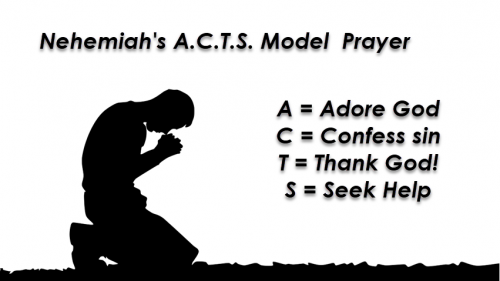
Nehemiah’s Prayer

Nehemiah 1/Ps 5 Pray and Wait Expectantly

Our prayer often sounds like this: God are you listening? Is my prayer falling upon deaf ears? I don’t see any movement from God. Nehemiah had to learn this principle: prayer warriors must be a “waiter and a listener.” We must use our time reflectively and then wait expectantly for God’s timing to happen. Like Hannah, Jeremiah and Daniel, and many others, Nehemiah did not just pray once but many days—in fact, it was four months before there was a breakthrough.  How long are you spending in a mode of prayer?

Like David in Psalm 5 Nehemiah began his prayer by asking; Lord carefully consider; or pay attention to my cry. Nehemiah knew he was a servant of King Artaxerxes but his real king was Jehovah. Like the psalmist, Nehemiah came in a mode of repentance. “I am praying to you today throughout both day and night on behalf of your servants the Israelites. I am confessing the sins of the Israelites that we have committed against you – both I myself and my family have sinned.” [Nehemiah 1:6]

Use today to pray for yourself, your family, your church, and your country. Use your time wisely. Spend time in prayer and “then wait expectantly for an answer” knowing that God rewards the godly and protects them with His shield.

Are you Prepared to go?

Cyrus God's Servant

Ezra 1-4 God’s Servant

What does a servant look like and act like? Ezra was a Jewish scribe living in Babylon during the 70 yr. captivity that God ordered to discipline his errant children. Jeremiah prophesied about it, Daniel read about it, and Isaiah prophesied about a king named Cyrus who would release them. Ezra was that person prepared to go when Cyrus released them!

Cyrus knew these facts: The Lord, God of heaven, had blessed him with the rulership over all the kingdoms of the earth.[Ezra 1:2] Secondly, he knew that this God of the Hebrews had enlisted him to build a house for Him in Jerusalem. So thirdly, he set about to carry out those orders by opening the storehouses in Babylon, where Nebuchadnezzar had placed the wealth of the Jewish Temple for over 70 yrs. ago! [Is. 44:28] Just think, God’s prophets had set the wheels in motion for all of this to happen, and King Nebuchadnezzar had willingly placed all the riches for 70 yrs. in safekeeping in the Babylonian temples.

Application for us: Long ago, in eternity past, God preserved us as His treasure and, at His appointed time, revealed us to the world for one purpose:  “so that [we] may proclaim the excellencies of Him who has called [us] out of darkness into His marvelous light;” [1Pet 2:9]

Cyrus willingly served the God of heaven, do we?

“What legacy are you leaving?”

What is your legacy?

2Chron 33 If someone would open your life’s diary what would they read? Would it be like the life of King Manasseh who had a godly father in King Hezekiah or would it read that you rebelled and refused God’s ways…until…

The Chronicler records these words: the annals record all of King Manasseh’s sins and unfaithful acts along with the sites where he built high places and erected Asherah poles and idols. Even though God spoke to him, he refused to listen. So, God disciplined Manasseh with hooks in his nose, bronze chains, and extradition to a foreign land where he languished in a prison cell with cold gruel, day-old bread, and water. It was then that his senses were awakened and he “realized that the Lord is the true God” and repented. [2Chron 33:13] It was because of the mercy of God that he was released and returned to his kingdom. God’s mercy is overflowing!

God has placed this event in His Word to remind us that it begins with a heart that is humbled but also that sin produces consequences not just for us but also for family and children. Manasseh may have repented but the damage was long-lasting. His son Amon followed in his footsteps of an unrepentant lifestyle and his life ended in an assassination.  

Generations come and go and we can learn much from the ancestral record. Hezekiah: godly. Manasseh: ungodly but repentant. Amon: ungodly to the end.

What would your diary say about your life?

What is your R.S.V.P.?

Jesus has an invite for you

2Chron 30 “An Invite that is Rejected.”

With great energy, Hezekiah continued his reforms for his nation. He wisely sought counsel from his officials and sought to protect Jerusalem from invaders while trusting in God to be his guide. He sought to reunite the kingdom that had been divided through the observance of the Passover and sent messengers with invitations as far north as Zebulun. But much like the people in Jesus’ parable in Luke 14, the people responded, Sorry, but I have work to do that cannot wait, etc. followed by “Please excuse me.” In addition, many mocked and ridiculed the messengers. 

In the parable Jesus taught, the invited had one main reason; they were “just.too.busy” to come. Their priorities were self first and God last; they were stubborn. How like the world today when the invitation is given to accept Messiah. They offer these excuses: that is ok for you but not for me or another time, or I am doing just fine and I don’t need God; or lastly, I am “just.too.busy.”

Those that chose to come to the Passover were blessed and rejoiced in the celebration. So it was in the parable; those that came filled the Master’s house to overflowing with rejoicing!

God’s invitation is for all. How will you respond? Are you ‘just.too.busy.’ or will you answer, Yes, Lord! 

Optimized by Optimole