What About Retirement?

Was retirement one of the topics you discussed when dating? Doesn’t seem an apropos topic for a date, does it  But then did you know God did?

Ps 78 sahring wisdoma

Numbers 8:23-26 There is no retirement in the Bible, right? When you are dating did you talk about this subject? Probably not but then again there are some who are forward thinkers and were thinking about that subject. Even God thought about retirement. In Num 8 he provided retirement for the Levites after the age of 50. Simply they were to retire from performing the work of carrying the tent materials.

How does one prepare for that stage of life? The psalmist [Ps 71] looked back and noted “that he had leaned upon God since birth” so he knew that God would sustain him in his old age when his strength failed. He and God were close friends. They walked and talked together each day much like Enoch. Like the retired Levites we are to share our wisdom with the younger generation. [Psalm 78] Are you developing the habit of teaching the younger generation about God? As a retired person are you looking for ways to mentor the next generation—even if you don’t have grandchildren!

How’s your attitude? They say if you are a grumbler in your younger days you will be a grumbler in your old age. Start now to develop an attitude of gratitude now so you will be a joy in your old age.

May I ask: Do you know God like that? Check out David Austin’s blog post on this topic: https://blogs.bible.org/director/david_austin/retirement_whats_next


A Letter from God to You

Are you feeling blessed today? God has written a love letter to you:

num 6 aaronic blessinga skyler-gerald-

Numbers 6:24-27 The Aaronic Blessing

“The Lord bless you and protect you; The Lord make his face to shine upon you, and be gracious to you;  The Lord lift up his countenance upon you and give you peace.”’

Within this beautiful blessing prayer, the name of Yahweh was prominently displayed as coming from Him, not a person. The words bless, keep, gracious, countenance and peace are sent from heaven upon His people. These are the words that God desires to bestow upon His people. Later Jeremiah reminded the Israelites in captivity of God’s love. “I have loved you with an everlasting love. That is why I have continued to be faithful to you.” [Jer 31:3]

So how does that translate to NT believers who are Gentiles? We were a wild olive shoot but are grafted in among the Israelites. This blessing is for us as well.

Today as you go about your daily routine stop and pray this blessing this way:  Father, bless me and protect me, make your face shine upon me and be gracious to me; lift up your face upon me and give me peace. Claim this promise from Jeremiah and make it personal. Father, I know you have loved me with your everlasting love and you have been faithful to me. With this upon our mind step forth into your work with His blessing upon you because you are His child!

What’s a letter without a signature? God adds his:

I will put my name upon you and bless you.


God is a God of Order

Numbers 1 to 3 ‘God is a God of Order’1cor 14 33

The theme of Leviticus is holiness; the theme of Numbers is obedience. The study note in the NET Bible study tool says: “It provides a record of the experience of the Israelites during the wilderness wanderings, and records the laws for the camp as they traveled from place to place. The book focuses on the difficulties of the Israelites due to their lack of faith, rebellion, and apostasy. It also records God’s protection of his people from opposition from without. The book makes a fitting contribution to the collection of holy writings as it shows the spiritual and physical progression of the company of the redeemed toward the promised land.” And so we begin our journey with them today.

These first three chapters guide us to see the order that God required of the infant nation of Israel because they had just come from servitude in Egypt. Therefore, God instructed Moses to do such and such. The end of each chapter reads:  They did all that God commanded Moses; that is what they did.

As Paul wrote to the Corinthians he told them:   These things…were written for our instruction, on whom the ends of the ages have come.[ 1Co 10:11] And again he wrote:  for God is not characterized by disorder but by peace [1Co 14:33]

The God who is not the author of confusion wants to be your God as well. He wants to guide you and bless you. Do you know Him?

Thanks to Pinterest for this photo.

Filled & Fed

Lev 24 “Lessons from the Tabernacle”

lev 24 menora2a

The Bible is replete with word pictures like the two pieces of furniture in the Holy Place in the Tabernacle. Each has a profound lesson about light and provision. The lessons should not be lost on us for us who are NT believers for each pictures Christ in His work.

The Menorah, a huge candelabra made of pure beaten gold, symbolized the Messiah. It was from this piece that branches, as pictured in John 15, must never be uncoupled from the center lamp. The cups were to be filled continually morning and night with pure beaten olive oil symbolizing the Holy Spirit. The shamesh, the center lamp, represents Christ as He illumines His church and His flock. It was never to be extinguished but filled regularly just as we once filled at salvation only need refreshing daily. Just as the priest was to fill each lamp daily, so Christ our High Priest should be filling us daily.  Be ye filled [Eph 5:18]

The table of showbread was filled weekly with 12 loaves of bread. The loaves of bread represent not just the 12 tribes of Israel but for the NT believer represent Christ as the Bread of Life, the Manna, the Bread of Heaven. We are to feed upon Him in His word for He is our provision.

Are we being filled daily as well as weekly? Tomorrow, as we begin our journey into Numbers, remember to be in His Word so we may be illumined and fed.

Filled and Fed

Lev 24 “Lessons from the Tabernacle”

lev 24 menora2a

The Bible is replete with word pictures like the two pieces of furniture in the Holy Place in the Tabernacle. Each has a profound lesson about light and provision. The lessons should not be lost on us for us who are NT believers for each pictures Christ in His work.

The Menorah, a huge candelabra made of pure beaten gold, symbolized the Messiah. It was from this piece that branches, as pictured in John 15, must never be uncoupled from the center lamp. The cups were to be filled continually morning and night with pure beaten olive oil symbolizing the Holy Spirit. The shamesh, the center lamp, represents Christ as He illumines His church and His flock. It was never to be extinguished but filled regularly just as we once filled at salvation only need refreshing daily. Just as the priest was to fill each lamp daily, so Christ our High Priest should be filling us daily.  Be ye filled [Eph 5:18]

The table of showbread was filled weekly with 12 loaves of bread. The loaves of bread represent not just the 12 tribes of Israel but for the NT believer represent Christ as the Bread of Life, the Manna, the Bread of Heaven. We are to feed upon Him in His word for He is our provision.

Are we being filled daily as well as weekly? Tomorrow, as we begin our journey into Numbers, remember to be in His Word so we may be illumined and fed.

Ye Shall be Holy

We often are reminded to be holy but what does that mean and how do we become holy?

holiness Lev 20a

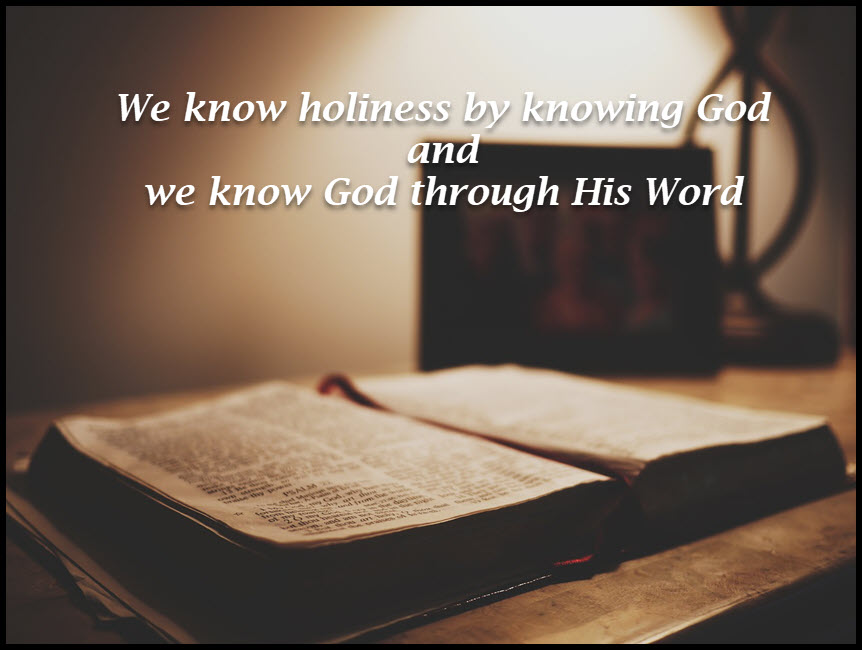
Lev 20 -23  The theme of Leviticus is holiness. Over and over the Lord spoke to Moses saying ‘I am the Lord,” You are to be holy. How can we know holiness? We know it through spending time in God’s Word every day. It is our guide to holiness, the holiness of God. Without His Word, how would we know His character, His ways, His standards?

And how do we learn about Him? How do we learn about our own holiness apart from the Word? The Word, that is “every scripture is inspired by God and useful for teaching, for reproof, for correction, and for training in righteousness,  that the person dedicated to God may be capable and equipped for every good work”

Think about it this way: “The Father gives you to the Son, the Son gives you to the Holy Ghost, the Holy Ghost gives you back to the Son changed and sanctified. Sanctified, but still a poor sinner. And the Son cleanses you with His blood, and clothes you with His own righteousness, and gives you back to the Father, through Him and in Him holy, holy enough for heaven, holy enough to stand in God’s holy presence” [Jas Vaughan, M. A.]


The Cost of Shed Blood

The next time you purchase meat at the market stop and think what that cost not in monetary terms but in terms of life.

Lev 17 blood.2ajpeg

Leviticus 17 “There is no Room for Compromise”

At certain seasons of the year, men go deer hunting. When a deer is killed the animal is hung to drain it of its blood. Blood represents the essence of life and therefore is to be protected. Men must not eat the blood of any animal.

In Genesis 9:6 we read: “Whoever sheds human blood, by other humans must his blood be shed, for in God’s image God has made humankind.” So we go from the taking of a human life to the eating of the life of an animal. In both, blood is life, it is sacred to God. The shedding of blood represents the taking of a life and then to partake of that life is anathema to God.

Leviticus 17: 11 “for the life of every living thing is in the blood.”

Thus God established these prohibitions for our protection. We are to be holy, set apart from the idolatrous nations that are around us.  We may not live in the wilderness but the prohibitions remain the same.

Stop and consider:

It was our Savior’s blood, his very life that was shed for us on that cruel cross.

Christ our Perfect Sacrifice

Do you see yourself as this picture; carrying around your sin? Beloved, Christ paid it all. He carried your sin and my sin to the uttermost part of the desert. They are gone never to return.

Lev 16 atonement2a

Leviticus 16  and “The Day of Atonement”

“Christ has come as the high priest of the good things to come. He passed through the greater and more perfect tent not made with hands, that is, not of this creation, and he entered once for all into the most holy place not by the blood of goats and calves but by his own blood, and so he himself secured eternal redemption.” [Heb 9]

Leviticus paints for us the picture of what the Israelites were to look forward to but now we look back to see its completion. Christ became for us the perfect atonement for our sin. Now we are allowed to enter boldly into the Most Holy Place because of His sacrifice. No longer does Aaron need to dress as he did to enter only once a year. Now because of Christ, we can enter at will at any time. Jesus became the sacrifice and the scapegoat all at once. He shed his blood which was then sprinkled on the mercy seat and became the goat which took our sins to the uttermost part of the desert.

Have you received this perfect sacrifice of Christ as your atonement?


What’s for Dinner????

Our world is replete with grocery markets, restaurants. What do the Levitical Dietary Laws have to do with us today?

lev11micheile-hendersona-Leviticus 11 “What’s for Dinner” is a question heard around the world! We all love to eat! Of course, we are speaking tongue in cheek here regarding that question because we are offered so many choices! It was not so near Mt. Sinai when God gave these dietary laws. The Lord spoke this chapter to Moses and Aaron that they might know His standards regarding what foods were clean and unclean as they lived their nomadic lifestyle. Now they were people of the book, people of Jehovah and were to be different and to follow these regulations as a separated people. They were not to be like the idolaters of the nations around them.

Remember James as he spoke to the dispersed believers? He did not mince words but told them that if they were friends with the world’s system that they were in enemies of God. That is why James hammered home their walk, talk, and their lifestyle. They must not mimic the world. Like Paul, he was saying they were to “come out from among them and be separate.” Thus Moses and Aaron are to teach the people these principles so they can be a holy separated people group. Thus God set a standard beginning with the most basic necessity—what foods were clean and what foods were unclean. There was essentially nothing wrong with those animals listed but the prohibition was to teach a symbolic lesson of what separateness means.

So the question is before us, do those around us see us as a different people group? In other words, when the world sees us what do they see? Does our life mimic the world or are we a people who choose God’s ways?

Strange Fire Consequences

aaron-burden-psalm 19 lev 10Leviticus 10   Do you excuse your or other’s sin? How does God feel about that when you do?  The evidence is pretty clear. King Saul was told to wait for Samuel but did not. Cain knew the right sacrifice was a lamb but presumed a gift of vegetables was ok. Ananias and Sapphira presumed a white lie was ok. A “friend” was caught in adultery and when chastised said, “God will understand.”

Nadab and Abihu, sons of Aaron, are like those examples. They presumed that taking a short cut was ok. They  took their fire pan, put fire into it; then set incense into it and went in to and presented strange fire before the Lord—“which he had NOT commanded them to do.”  Immediately, fire went out from the presence of the Lord and consumed them so that they died before the Lord.”

Yes God understood all of those people.  He understood that each presumed He would overlook their sin but learned all too late that the consequences for presuming is deadly.

Whereas we are quick to excuse sin, God does not. Take heed to King David’s words: “keep back Your servant from presumptuous or flagrant sins; Let them not rule over me; Then I will be blameless,”[Ps 19:13]

Optimized by Optimole