God is faithful …even if we are not!

God is faithful even if we are not

Lamentations 1 to 5 “There is hope”

In Israel, long ago, God raised a prophet to tell God’s saving message, but the people turned away. For over 45 yrs. Jeremiah faithfully reminded the people of their sins and consequences, in sharp contrast to the false prophets who failed to expose their sins.[Lam 2:14]

And so, just as Jeremiah prophesied, the nation was physically and spiritually destroyed. God’s discipline was harsh and long, and it broke Jeremiah’s heart. As Jeremiah wept, we should also.

Today we hear much the same.  Don’t tell us the truth of our wickedness! We can decide who lives or dies. We can change our gender. Those are lies from the enemy, and he has been busy since day one saying, “you can be gods.” Many today are hearing but rejecting the gospel message just like in Jeremiah’s day. We should weep for them. We should weep if we have failed to share the truth. [Ezek 3:18] Jeremiah poured out his pain in his prayers. Do we also cry for those who have heard but rejected and also those who have yet to hear?

Amidst this calamity, Jeremiah recalled: “The Lord’s loyal kindness never ceases; his compassions never end. They are fresh every morning; your faithfulness is abundant!” [Lam 3:22] There is hope!  Paul also reiterated this truth: “If we are unfaithful, he remains faithful, since he cannot deny himself.” [2Tim 2:13]

Hope…a necessary element

Hope keeps us grounded

Jeremiah 50-52 And So Jeremiah brings his book to a close…but…

While listening to the lecture on Titus, the teacher made this observation: without hope, people are lost. Is that why God gave Jeremiah those words? “It is he who made the earth by his power, who established the world by his wisdom and by his understanding stretched out the heavens. When he utters his voice, there is a tumult of waters in the heavens, and he makes the mist rise from the ends of the earth. He makes lightning for the rain, and he brings forth the wind from his storehouses.[Jer 51:15,16]

In challenging times we all need this view of God so we do not lose hope. God’s plans are higher than ours, so said Isaiah in Is 55:8-9.

Do I keep the vision of God before me so I do not lose hope?

Whom do you fear?

Whom do you fear?

Jer 47-49 God gives Jeremiah His words regarding the nations around Judah who worship idols, and the message has bad omens. You will be defeated! God tells Jeremiah this about Moab: “you trust in the things you do and in your riches.” and “Your god Chemosh will go into exile along with his priests and his officials,. Your god Chemosh will go into exile along with his priests and his officials. “[Jer 48:7]

God singles out Moab because of their child sacrifice practices to the idol Chemosh. Today we have the same sin in our nation with the sin of abortion. It grieves the heart of God, and my own heart is grieved.
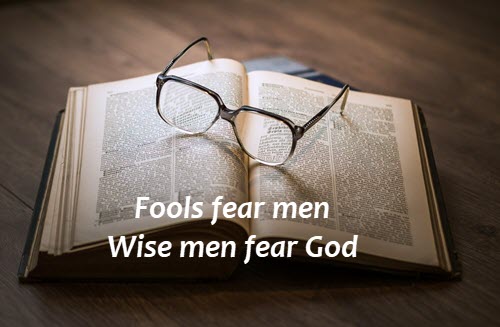
Solomon wrote that we must fear God, not man, yet men refuse to do that. The most significant and alarming sin is that of pride. “Fearing the Lord is the beginning of discernment, but fools have despised wisdom and moral instruction.” [Prov 1:7]

May I not be found as a fool but as wise.

Doubter or Believer?

doubt or believe

Jer. 43-46 From Genesis to Revelation, we read over and over, in one form or another, that our God can be trusted because, unlike men who change their minds or vacillate, God never does. The clearest example: Num. 23:19 “God is not a man, that he should lie, nor a human being, that he should change his mind. Has he said, and will he not do it? Or has he spoken, and will he not make it happen?”

Therefore, when the people came to Jeremiah to ask for a word from the Lord, he complied, but when they heard the word, they claimed he was lying. When people don’t listen to what they want to hear, they often do as these Judahites did. People are untrustworthy, unlike God, who is. Also, they add to God’s Word, so it is palatable. God is not amused. He tells Jeremiah that these people are stubborn and rebellious—even when they see the evidence of truth. So how’s that working for them?

Why are we so slow to believe? Jesus said the same thing to the two on the road to Emmaus: “You foolish people—how slow of heart to believe all that the prophets have spoken! [Luke 24:25]

Today do I believe all that the Word of God says, or do I try to change it to fit what I want, not what God wants for me?

Faithful or Stubborn?

will we believe and obey

Jer 40-42 What God said would happen happened. The Babylonians took over Jerusalem and carted off its people. God graciously opens the heart of Nebuchadnezzar and allows the prophet Jeremiah to go free. He is given two choices, go to Babylon and live with Nebuzaradan or return to his people. “He stayed there to live among the people who had been left in the land of Judah.” [Jer 40:6] Jeremiah loved his people so much that he was willing to suffer in a land of devastation rather than go to Babylon and live there in relative peace. So how do we decide what to do? 

Once back there, we find that the people still have stubborn hearts. They ask Jeremiah to inquire of the Lord what to do next and end their request with “what He says, we will do.” That is reminiscent of the Israelites before Moses in the book of Numbers. But, as then, so now, when they hear what God says, they say, that cannot be! Jeremiah, you lie! We are going to Egypt. Before, they wandered for forty years, and the disobedient died in the wilderness. Now they will die in Egypt —just as God said.

God places choices before us as well, and we must decide. We don’t have a Jeremiah to inquire before the Lord for us, but we do have His Word. Will we listen? Will we obey? Indeed we are stubborn people. Peter learned this lesson: “His divine power has bestowed on us everything necessary for life and godliness.” [2Pet 1:3] How about us? OR-—

Do we need to do another lap around the wilderness to learn? Will we believe and obey?

How’s fear working for you?

how's fear working for yo?

Jer. 37-39 Our arch-enemy wants us to fail and not just fail but fail BIG TIME! His biggest tool is fear. He knows that if we fear God, we can be conquerors, but if he can change that to fear of men, he has won, and we have lost. Take King Zedekiah, a prime example of Prov 29:25 “The fear of man is a snare, but he who trusts in the Lord will be exalted.” Zedekiah lived by fear. He sent for Jeremiah in secret to know what God had planned. Jeremiah told him to yield to the Babylonians, but Zedekiah’s fear overruled him, and he sought to escape through a tunnel at night. He chose not to do as Jeremiah said, and the fruit of his fear came to pass. The Babylonians found Zedekiah; Nebuchadnezzar killed his sons, took his eyes and bound him, and sent him packing to a Babylonian prison.

God has his way of proving His Word is true. Zedekiah is a sad tale of what happens when we yield to fear. 

So, here’s our question: How did Zedekiah’s fear work for him? How does that fear work for us?  

Handling the Word of God

The Word

Jer 33-36 In the time of King Josiah, the word of the Lord was found and read. He tore his clothes and ordered that the false images be torn down, and they return to God’s ways. God honored Josiah, and his reign was one of peace. King Jehoiakim also heard the word of the Lord read, but he dishonored it by burning it paragraph by paragraph. God told Jeremiah that because he did that, he would die an ignoble death and have no descendants to sit on the throne. In the book of Galatians, Paul writes that God will not be mocked. People will reap what they sow. [Gal 6:7]

How do I handle God’s Word, especially when the Spirit speaks? Do I do as the king when I read something that pricks my heart but gloss over it, or do I do as Thomas Jefferson and cut out those passages I don’t like? Today men say those words were for another time, but God’s Word will never return void. [Is 55:11]

May we honor God’s Word and remember that where our treasure is, there our heart will be also. [Matt 6:21]May we be like Josiah or Mary, who “treasured up all these words, pondering them in her heart what they might mean.” [Luke 2:19]

There’s a New Day Comin’

There's a new day coming

Jer 30-32 In 1933, a song was published that must have encouraged our nation coming out of the Great Depression. It was called “A New Day is Coming.” Jeremiah was “singing” that tune long before this to the children of Israel as they sat waiting and watching the Babylonians build siege ramps outside the city walls. They were asking, can anything good come out of this? Jeremiah repeated the words of God: “…is there anything too hard for me?  “I am the Lord, the God of all humankind. There is, indeed, nothing too difficult for me.” [Jer 32:27] If I could create this world out of nothing, I can surely bring you back and replenish this land and My people. As the sun rises and sets, my Word will never pass away. [Matt 24:35] What I have said, I will do. [Is 38:7]

Why does He do that? It is because He has “loved you with an everlasting love. That is why [He] has continued to be faithful to you [Je 31:3] and because He is Father, and that’s what fathers do. [Jer 31:9]

Keep looking up; a new day is coming!

True or False Prophets

test the spirits

Jeremiah 27-29 Back in Moses’ time, the people asked Moses how to tell and discern if a man speaking “for God” was really ‘from God.’ So Moses gave them a guideline. If what they say will happen happens, he is a true prophet, but if what he says does not happen, he is false and should not be feared. (Deut 18:21-22) Sounds so simple but is it that simple?

Today we have some who predict that our future will be rosy and comforting, but the signs on the horizon predict otherwise. How can we tell if what we hear is right or not? We must take all who speak and then ask God for clarification, just as James said: “if any man is deficient in wisdom, he should ask God. [James 1:5]. The same tests apply today as they did back in the time of Moses. Watch, listen and pray for discernment. Study the scriptures, and do as the Apostle John said; ‘test the spirits’ to see if they are from God. [1Jn 4:1] But how do we do that practically?  What we hear should not contradict what God has said before and must confirm what scripture teaches “every time!” Listen to their claims. Are they just telling me and you, the listeners, what we want to hear like Hananiah did in Jeremiah’s time, or is it a message to prepare us to repent so God can fulfill His purpose? [Jer 29:11]

How to be discerning

Listen, look then determine

Jer 21-23 Today we hear many voices. They sound right, legitimate, and pleasant, but are they? One of the challenges we face and the people in Jeremiah’s day faced is discerning whether the messages were from God or not. They had to, and we have to sift between what is true and false. The only difference between the time of Jeremiah and now is that we have the completed Word of God, 🙂 which is profitable for teaching, reproof, correction, and training in righteousness. [2Tim 3:16] The Apostle John’s advice to his flock was to ‘test the spirits to see if they are of God.’ [1Jn 4:1] Ask: Has what he has said in the past come true? Has his life been exemplary?

Long ago, people mostly listened and had to determine if the speaker came from God or not. So God gave them three ways: (1) prophets to speak for God to the people; (2) priests to speak for the people to God and (3) a king to help them adhere to the covenant.

Today, we have the indwelling Holy Spirit who speaks to us through the completed Word of God. Therefore, we must know the Word to discern and to do that, we must “store up His Words in our heart” [Ps 119:11] which means we must make every effort to memorize it. It is our reasonable service, as Paul said. [Rom 12:1]

Today as you listen to the many preaching, speaking, and writing, be sure to apply James 1:5 “if deficient in wisdom, ask God.”

Optimized by Optimole