
 One day in the teaching ministry of Jesus, he told a parable about a Pharisee and a Publican to illustrate the truth of those who were confident in their own righteousness while they looked down on others. In much the same way, Saul, whom we meet in Acts 9 is a picture of that Pharisee. His prayers might have sounded just like the Pharisee: “God, I thank you that I am not like other people:” …in addition, God I thank you I am not one of those followers of that Jesus pretender. And so with that mindset, Saul set out to murder the Lord’s disciples not only in Jerusalem but also in Damascus. But unbeknownst to the high priest and Saul, God had a different plan. He needed a Jew who was a scholar, fluent in both Greek and Aramaic, knowledgeable in the Torah and the Prophets. Who better to fit that bill than Saul! Clearly, Saul must have overlooked Is 55 “my ways are higher than yours, and my plans are superior to yours.”
And so it was on a dusty road that Saul met Jesus first hand and it radically changed his mind, his heart and his lifestyle. He wrote later: “I have suffered the loss of all things – indeed, I regard them as dung! – that I may gain Christ,”[Phi 3:8] Saul, soon to be Paul, now picked up where the martyred Stephen left off unapologetically proving Jesus is the Christ.
Beware lest you think like Saul—Jesus may meet you and your life will be forever changed.
 From the outset, Jesus had to deal with 12 unruly men who argued and passionately desired to be the greatest, but when the Holy Spirit came and indwelt them, all of that changed. Their desire now was to study, pray and impart wisdom to the new fledgling church.
 John Wilbur Chapman penned the words of the hymn “Our Great Savior.” The words echo the psalmist prayer “Saving, helping, keeping, loving, He is with me to the end.” This is why we can be confident in the Savior who came, lived, died and rose again. He has faced all we have faced yet without sin.
 As we read this last chapter in Luke we wonder why he did not focus on just the beauty of the resurrection. Dr. Luke is drawing us into these real life scenes that we might relate as to why there are those today who also cannot understand the resurrection and see how God is at work amongst us. We are brought front and center that we might learn from these encounters as a means to share the gospel message.
 “people are appointed to die once, and then to face judgment,”[Heb 9]. Our question is: are you prepared for your entry into eternity? In Luke 23, we are presented with three candidates for us to observe and determine ours.
 In the opening verses of Job, we find the villain Satan in the presence of God as the accuser of the brethren who has been on the prowl looking for someone to devour. [1Pe 5:8]
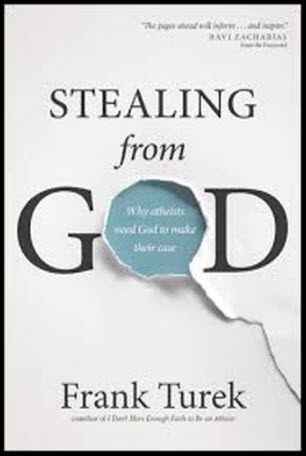 Frank Turek, author of “Stealing from God” wrote: “the amazing evidence of God’s sovereignty is revealed in how even those who don’t believe in Him call upon Him to remind them of the source that paved the way to their disavowal of belief in His existence.”
 “Though troubles assail us and dangers affright” are the first words of the hymn written by John Newton. In the third stanza, he writes “when Satan assail us …we triumph by faith.” But even though we are people of faith we are also prone to think God is ‘afar off.’ The psalmist’s words echo back to us: “You are near Lord!..the Lord is near all who cry out to him.” [Ps 119/145]
 As a parent these words have been heard more often than not when an older sibling gets to go do something but the younger only hears the ‘no.’ Do we think that it is just a parent that has to say ‘no’?
 Jan 3rd Luke 2 “Being Used by God”