Preparation

Ps. 111- As you read each day, ask God to reveal Himself to you. Ask Him to open your eyes, ears, and heart. Then do as the Psalmist: give thanks to the Lord with your whole heart. [Ps 111:1 paraphrase] Praise Him for His work is majestic and glorious, and his faithfulness endures forever. [Ps 111:3] Praise Him because all his precepts (commandments) are reliable and forever firm. [Ps 111:7]

The Psalmist closes his meditation by exclaiming: “All who carry out/practice his precepts acquire good moral insight.” [Ps 111:10]

Take time today to meditate on these verses from this short psalm to prepare for your day. Then share with us your thoughts.

Are we praising God today?

Ps 50; 53; 60; 75 The psalmist is struggling with the attitude of ungratefulness. He has presented his offerings, but they are insufficient because of a hard heart. Just doing things outwardly is not what God desires, He desires inward repentance. It is not the sacrifice but the sacrifice of praise. Heb 13:15 “continually offer up a sacrifice of praise to God, that is the fruit of lips that give thanks to His Name.” Romans 12:1 reminds us that God looks for the inward heart and is pleased with us being a living sacrifice.

Where are we a living sacrifice today? Where are we offering a sacrifice of praise?

A Tale of Three men and the Lessons for Us

Fall Festival With Leaves.pngDoes character count? How do we evaluate?

3 John  A Tale of Three Men and the Lessons for Us.

The Apostle John wrote a snail mail letter to the church. He had no hesitation of having it read publicly; in fact—he published it on the open market! So what did he say and why should we read it too?

This is a tale of three men with different character qualities. Two are good, we might even say great, but then there is that one that is ugly to the core. If written today, we might call him a “stinker.”

Two men, Gaius and Demetrius were truth seekers. The church testified that they loved Christ. The Apostle John called Gaius both brother and friend, which show us their close relationship. In addition, Gaius was esteemed because he was also hospitable to the itinerant preachers as they came to town seeking food and provisions. He opened his pocketbook more than once, it seems, so John encouraged him to keep supporting these traveling preachers.

John adds that he rejoiced because others testified to both men’s faithfulness.

Now, as to Diotrephes, the no-good church member, the one we might call a “stinker.” It seems he had a problem with pride. John wrote,  “he loves to be first among them.” If others didn’t shower praise upon him, he just wrote them off his list. If that didn’t get their attention, he ushered them out the back door much like the Pharisees did to the early apostles. Both Diotrephes and the Pharisees had a problem of envy or being jealous. Beloved, jealousy happens when we fear others getting the attention we feel is justly ours. Can you resonate? Sometimes that sin enters our life as well so we need to be on guard. Remember, even Pilate saw through the cracks of the Pharisees and John saw through Dioterphes’ cracks as well.

So what is our “take away” from what John wrote?

 Be grateful for the faithful. Be discerning and lovingly rebuke those who have a character flaw.

But in the end,  remind yourself of this truth: 

“the one who does good is of God; the one who does what is bad has not seen God.”

So does character count? I guess we could say it does. If John were to write about you, what would he say? 

Are You Drifting?

hebrews 2 drifting dreamstimeIn chapter one of Hebrews, as believers in Christ, the author encourages us to rejoice in our Savior because he is the radiance of God’s glory. We extol his name and we praise him in song  in word in the assembly of the righteous,

BUT….. here are the questions before us:

  • What do we do when we leave that assembly?
  • Do we leave our praise there or do we carry it with us in our quiet time as well as our work-a-day world?

Jesus came in human form to suffer death to release us who were enslaved to the one who had the power and fear of death. Jesus came to overcome so that he might bring us to glory where before the Father he will call us brothers and sisters.  The cost was exorbitant, the pain was great, the temptations were without measure—he did it all for us. That is why we must not drift; we must not neglect this great salvation.

This is the message that we must carry with us in word and deed: “Christ died for our sins according to the scriptures, and that he was buried, and that he was raised on the third day according to the scriptures,” [1Cor 15] It was first announced by Jesus then confirmed to others who then passed this on to us through the gifts of the Holy Spirit for one reason: we might carry the message to the next generation.as Psalm 78 encourages us to do!

“We will not conceal them from their children,
But tell to the generation to come the praises of the Lord,”

Are you tethered or drifting?

Photo: Dreamstime

Watch Night Service and Praising God

ImageDoes your church have a “watch night” service planned for the last night of the year? Many churches offer services held on this evening culminating with rejoicing and feasting after a service of singing, praying and testimonials? In growing up that was one of the highlights of Christmas vacation! I always loved going to be a part of the praise and worship and then after midnight someone would hug me and say “Happy Birthday!” That was a marvelous way to begin not only a new year but also to begin my celebration—even though it was always a bit embarrassing at the moment. Watch-night services are not a new idea; Charles Spurgeon held a “watch-night” service on Dec 31, 1855 and “hoped that the Lord would own the service and thus souls might be saved.” What better place to reflect on the end of one year and the beginning of a new year.

Today’s reading in Psalm 148 to 150 guides in what we could include on this “midnight-eve” time of reflection.

For what to praise: Ps 148: Praise God for his revealed attributes see through his creation: “For since the creation of the world his invisible attributes – his eternal power and divine nature – have been clearly seen, because they are understood through what has been made. So people are without excuse.” [Rom]

With whom and how to praise:  Ps 149: Praise Jehovah in the assembly of the godly. “With renewed zeal and fresh delight lift up your song unto Jehovah. Sing unto the LORD a new song. Sing, for it is the fittest method for expressing reverent praise. [C.H. Spurgeon]

Where to praise: Ps 150: Praise God in his sanctuary. Praise him when you view the sky; for his mighty acts, his surpassing greatness. Praise him with song and musical instruments. Let us all with one accord praise the Lord.

If your church has not planned such an event, you could invite others to join you in your own “watch-night” time of reflection and praise the Lord using these three psalms. I wish you all blessings from on high as you reflect and pause to praise the Lord for a new year to serve him.

 Image

And all of the people said “Praise the Lord!”

 ImageThe writer of these psalms wisely counsel us to praise the Lord for He is God, and His lovingkindness is ever before us in all we see and experience. “While we are studying this holy Psalm, let us all along see ourselves in the Lord’s ancient people, and bemoan our own provocations of the Most High, at the same time admiring his infinite patience, and adoring him because of it. May the Holy Spirit sanctify it to the promotion of humility and gratitude.” [Spurgeon]

The psalmist begins with a hallelujah chorus and we would do well to begin our prayer time in this way. Vs 2 reminds us that God’s mightiness is recounted but our memories and our words are inadequate for God is greater than what we could ever tell. Joh 21:25 There are many other things that Jesus did. If every one of them were written down, I suppose the whole world would not have room for the books that would be written.

So who can tell? Only those who walk in close communion with God and have been anointed with the teaching ministry of the Holy Spirit for he Joh 14:26 But the Advocate, the Holy Spirit …will cause you to remember everything I said to you. It is then that we are able to recount and tell of  the mighty deeds which God has done, maybe not to the fullest, but our memories will be so filled with His love and power that we are like the psalmist will stand in awe of God and be humbled. It is then that we say with the psalmist: 107:1 “Oh give thanks to the LORD, for He is good, For His lovingkindness is everlasting.” It is when we begin and end our meditation with these thoughts that we are satisfied because we have hungered and thirsted: Matt 5:6 “Blessed are those who hunger and thirst for righteousness, for they will be satisfied.” It is then that we are emboldened like the Samaritan woman to her village or Andrew to Nathanael will say “Come and see…” Come and see the man who is Messiah, come and see for yourself that this is the one we have waited for. It is then that we say with the psalmist “107:2 Let those delivered by the Lord speak out,” and we end with  “Let all the people say, “We agree! Praise the Lord!”

Image


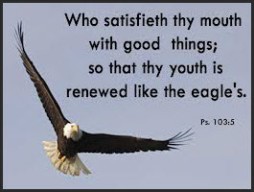
Soar Like the Eagle!

ImageA good question to ask oneself might be: Where am I today in my spiritual walk? Have I stopped to thank God for His many provisions of blessings?

 In Psalm 102 we find that the psalmist is “in the pits.”  The psalmist  visualizes life alone, life without hope. “I am like an owl in the wilderness;”  bereft of friendship and like a ruin that has been abandoned;  like the solitary bird on a rooftop, alone and separated from company.  In sharp contrast, in Psalm 103 he is soaring like the eagle, the bird that commands the heavens with its ability to fly to the heights of the clouds and descend with a crescendo to capture its prey, in control over others. C.H. Spurgeon wrote: Renewal of strength, amounting to a grant of a new lease of life, was granted to the Psalmist; he was so restored to his former self that he grew young again, and looked as vigorous as an eagle, whose eye can gaze upon the sun, and whose wing can mount above the storm. It is in this time that the psalmist reflects how blessed he has become because of the Lord’s provision and protection.

In reading this psalm reflect on the word “all” and count the many ways that God has touched your life. As a pastor and poet, H. F. Lyte did just that and wrote a famous hymn “Praise, My Soul, The King of Heaven.” The first stanza sums up his thoughts as he reflected in his time of prayer and praise:

 Praise, my soul, the King of Heaven;
To His feet thy tribute bring.
Ransomed, healed, restored, forgiven,
Evermore His praises sing:
Alleluia! Alleluia!
Praise the everlasting King.

Take time today and ponder the many blessings that God has placed before you. “God’s blessings… include forgiveness of sins, healing from sickness, deliverance from death, enrichment of life, satisfaction, and rejuvenation.” [Constable].

Ponder the eagle as a picture of rejuvenation. The eagle mates for life, builds his nest at the very tops of trees, remains strong and lives the longest of any bird, often to 38 yrs. The eagle remains vigorous, symbolizing power, freedom and transcendence, meaning that they surpass and exceed in superiority to the end of their lives. “Likewise God enables His people to remain spiritually vigorous until death.” [Constable]

Where are you today in your spiritual walk? Stop and meditate upon this psalm today and be renewed like the eagle.

 

It is Fitting…and no this is not about clothes!

ImageHow fitting to follow Romans 11 with  Psalm 92 and 93  which teach us much about humility, about the Creator, the Sovereign One in all of His fullness, and His work. The psalmist says it is fitting (it is a beautiful thing, it is a good thing) that we should give thanks to the Lord Most High! Stop and give Him praise today for Vs. 5 He works are great, His thoughts are deep; Vs. 8 He reigns forever; VS. 10 He has chosen to exalt the righteous and anointed us; Vs. 12 He promises that the  righteous will flourish; and Vs. 14 He promises as the palm continue to be fruitful even in old age. How marvelous is our God!

As the psalmist walked about and observed the workings of the Temple and the Palace of the King he came away with a picture of God’s provision for those He has blessed. The cedar is mentioned 51 times as Cedar and 24 times as Cedars in the Bible. Because of its strength, longevity, its height, and its durability it was chosen for the building materials to construct the Temple. Its walls were lined with cedar, on which were carved figures of cherubim, palm-trees, and open flowers, which were overlaid with gold. (Wikipedia)

ImageThe palm also is a picture of longevity and in fact continues to provide fruit even when old, is continually filled with vitality with  many leaves. In the cedar built courtyard, the palm provided shade in the heat. Sequestered in the court it was protected against the desert storms and fluctuating temperatures and it is here that it was nourished and protected.

Both of these trees give us a beautiful picture of the righteous who has chosen to dwell in the courts of God. Psa 84:10 “Certainly spending just one day in your temple courts is better than spending a thousand elsewhere.” Psa 65:4 “How blessed is the one whom you choose, and allow to live in your palace courtsImage

We thank thee Our Father for these beautiful pictures of the righteous. May we give you thanks and praise! You truly are the Lord Most High…and thus it is fitting, right, correct, and my duty to praise Thee!

Rom 11:36 For from him and through him and to him are all things. To him be glory forever! Amen.

Is Life Fair? Find the Answer in Ps 73.

ImageIn Matthew 18, Jesus took time to quell the bickering of the disciples using the illustration of a child’s humility. He also gave them a stern warning to not be a stumbling block for ones who are new in their faith or just beginning to grow. Today we meet a man who long ago faced this same struggle. The musician and seer Asaph wisely teaches us how to handle temptations to be a stumbling block which is one of the enemy’s tools.  This is one of the wisdom psalms from which we learn practical points of life.

Asaph begins with extolling God for His goodness and purity of motives. But, he is struggling as he sees those who are wicked who are prosperous, proud, and popular. We too face that struggle when we look about us rather than looking at God. Asaph personalizes his struggles with his perspective on life for us and in it teaches us some wise principles.

Life is not fair. Asaph as a paid religious worker in Temple worship just didn’t seem to cut it. It is not fair. Others are materially prosperous also are proud and pompous, while I am poor and suffer adversity. They lack for nothing and live life with a “God owes me this” mentality. I am a man of integrity and yet like Job or Joseph I am facing problems. Where is my material prosperity God? Why do I face problems? If you are God why am I suffering? Today we see and hear the same refrain. It seems that this is a point that is ages old. The problem is failing to see life through the lens of the eternal perspective.

There are three keys we want to note: vs 3 “I envied” Envy is a sin that began in the Garden of Eden and is alive and well today. Secondly, notice how Asaph pondered what to do:  73:15 “If I had publicized these thoughts, I would have betrayed your loyal followers.” Translation: I would become a stumbling block! Today:  How often do we share via prayer requests our struggles without considering what those might do to a young believer’s faith? Thirdly, 73:17 Then I entered the precincts of God’s temple, Asaph came to the sobering reality that first he harbored the sin of envy for which he needed cleansing. Secondly, Asaph pondered the consequences of being a stumbling block to others so wisely he sought the counsel of God.  Lastly in God’s presence he saw the reality: We are here for one purpose: to behold His beauty and to worship Him in all of His fullness. I think Lazarus might have had that perspective right and the rich man had the “God owes me mentality” in Luke 16. In the end, who was really blessed? Asaph comes to this same conclusion.

There is a praise hymn which seems to sum up our thoughts for today: “In the presence of Jehovah, God Almighty, Prince of Peace, Troubles vanish, hearts are mended, in the Presence of the King. Through His love the Lord provided….

That is the key. It is in the presence of Jehovah we find all our answers to life’s problems.

Image


Worthless vs Ideal Words [ Matt 12 &Prov 16 ]

ImageI love this picture to the left because it reminds me that even if I am faithless He is faithful.

I don’t know if you can relate but often have I cringed at something I have just said and the verse in Matthew 12 comes back to convict me.  It is then that I am reminded that I do need to more carefully choose what I say so that I am honoring God and my fellow man.

Pro 25:11 Like apples of gold in settings of silver, so is a word skillfully spoken.

Proverbs chapter 16 begins with these words: The intentions/plans of the heart belong to man but the answer of the tongue comes from the Lord;  but Jesus teaches:  Mat 12:36 I tell you that on the day of judgment, people will give an account for every worthless [idle] word they speak. It almost seems that these two sides of the coin teach opposing views. It seems like really we have no choice as to what we speak.  But is that true? We know that God does not contradict Himself. So our question is….Why are some words worthless and how do we harmonize these two verses?

 When men plan/think/reason using the gift that God has given them and trust Him to guide them then the responses we give will be His for we are His workmanship, created to accomplish good works [Eph 2:10]. If however, we refuse to plan, decline to consider, are unwilling to listen to wise counsel, are unwilling to see ourselves in need of wisdom, and allow pride to govern, then our words are idle or worthless and for these we will held accountable. A biblical truth is that God has graciously given us the ability to think and reason. Therefore, it behooves us to ponder and seek that godly wisdom that is given to men who desire His will and way. In that way we will speak and honor Him with ideal words that bring Him glory.

Father, Today may I be certain and give you praise for You because You care about each word, each direction, each decision that I  make. I can know that because you say so: ‘I have loved you with an everlasting love. That is why I have continued to be faithful to you. May I seek your will and your way that we bring glory to you alone. May I  boast that I know and understand that You, the Lord, act out of faithfulness, fairness, and justice in the earth. [Jer 9]

Optimized by Optimole