God’s Plan & His Love

God's love

Deut  28  and  29  God’s  Plan      

God’s  plan  is  pretty  simple:  obedience  leads  to  blessing  and  disobediences  leads  to  curses.  His love is deep and wide. It extends not to just the Jew, but to each Gentile believer as well. Not  only  is  that  true,  but  His  love and His principle for life is  as  clear  as  day:  “For  I  know  what  I  have  planned  for  you,’  says  the  Lord.  ‘I have plans to prosper you, not to harm you.  I  have  plans  to  give  you  a  future  filled  with  hope.”  [Jer  29:11]  Yet,  even  though  this  is  written  for  our  admonition  we  are  much  like  the  Israelites,  a  stubborn  people.  We  want  to  come  to  God  on  our  terms,  not  His,   and  then  we  wonder  why  we  are  faced  with  such  grievous  lives.  He  reminds  us  that  “The  secret  things  belong  to  the  Lord  our  God,  but  those  that  are  revealed  belong  to  us  and  our  descendants  forever,  so  that  we  might  obey  all  the  words  of  this  law” [Deut 29:29].

Today may we choose to honor Him from whom all blessings flow and watch and see what He will do!
Be a Blessing to Someone Today

Blessing others means you are blessing God

Deut 23 “Be Creative as you Love Your Neighbor.”

Both Moses and Jesus taught us that we are to love God with all our heart, soul, and strength, and secondly, love our neighbor as ourselves. Paul taught the Thessalonians that same principle; meet the needs of those who are your brothers and sisters in the Body of Christ.

Moving beyond the inner circle, God taught ancient Israel that if one became hungry while walking to the next destination, they were allowed to enter a neighbor’s vineyard and eat as many grapes as needed, but they were not to collect any grapes for another time. Jesus and the disciples followed that principle. Later, the Pharisees said that it would be considered work, not what is needed if it happened on a Sabbath. God did not say only six days a week but anytime. Be careful of adding to God’s word.

Be creative today as you go about your busyness. Stop and look where God might be working, and you can be His servant.

What Do You Want God to Do For You?

Be sure of your motives when you pray

Deut 17  God knew the Israelite kings would lose sight of Him because most of their wants were selfish. That is why God gave the king some parameters to keep their focus heavenward, not here on earth. Like the king, the Israelites were not satisfied with just manna. They wanted meat a.k.a. horses, women, and money. That is why God reminded them to not multiply them.

When Jesus came on the scene, people were looking to be fed what the world would give rather than the Bread of Life come down from heaven. In fact, while Jesus served here on earth, he often asked, “What do you want me to do for you?” Not one responded I want to be more like you. Not one responded, “The Lord is my Shepherd; I lack nothing.” Not one responded I am more blessed to give than receive.

It is not wrong to ask God for things because He is our heavenly Father; “All generous giving and every perfect gift is from above, coming down from the Father of lights, with whom there is no variation or the slightest hint of change.” [James 1:17] God does tell us to ask for His provision in our life as well as other things. However, when we ask with wrong motives, so we may spend it on our selfish pleasures; God is not pleased.[James 4]

Are you prepared to ask God what He wants for you and not what you want?

Is your heart right before God as you enter your closet to pray?

Remember–then Share

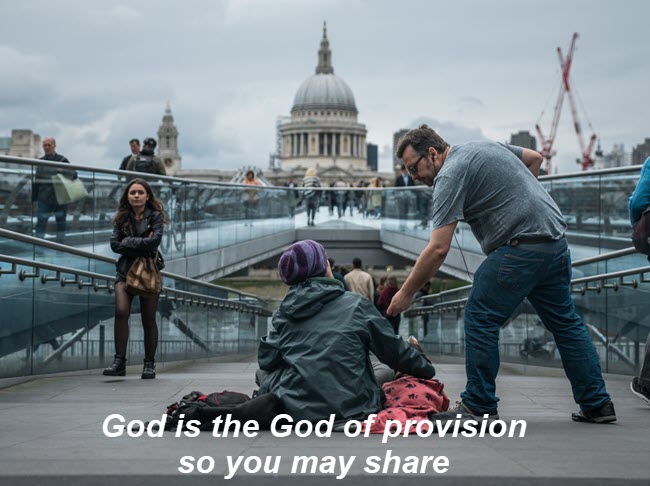
God provides so we may share

Deut 14 to 16 We set aside different dates to remember various events, and soon we will remember the death, burial, and resurrection of our Lord. God set aside dates so the Israelites would recall events in their past and how the God of their provision was a God of promise. It is a privilege to know that one is chosen and elected to serve the most Holy God of the universe; thus, each date is to be a celebration of what God has accomplished.

As we celebrate, may we also remember the poor among us who have little to bring to the altar of sacrifice. We who have much are then to give out of our abundance to supply what the poor lack. We must not “must not harden our heart or be insensitive to his impoverished condition. Instead, open your hand and generously lend him whatever he needs.” [Deut 15:7]

Today many are poor due to extenuating circumstances due to the COVID. Today, some are in our communities, some in our churches, and some are homeless as they have lost all. Our hearts must be open to giving and giving wherever God reveals. We must remember that God is the God of provision, and He has blessed us beyond measure so that we might be able to reach out and touch the lives of those who in need.

God provides so we may share.

Deut 11 to 13 Beware

God's word

Deut 11 to 13 Over and over, Moses has warned the people to listen and heed the words of the Lord. It is He who brought them out of the land of Egypt, a land of bondage. Looking ahead, he could see a time when they would instead do what is right in their own eyes. Later that prediction would come true in the Judges’ time when they turned their eyes away from the living God to the false gods they were to eradicate from the land. How quickly we fall victim to the delusions of what Satan puts before us. Paul warns us of this in 2Thessalonians [2Thess 2:11]. When men refuse to believe, God will send a deluding influence so strong that even if they want to believe, they can’t because they have refused the saving grace of God.

That is why Moses set before them a blessing and curse lest they fall victim to the deluding influences of the false gods in the land of milk and honey. He reminded them to be certain to keep all the statutes and ordinances that he presented to them.

What is the warning to us this day? We must test the spirits; we must weed out those who present false doctrine as truth. We must not believe every word but check it with scripture, for scripture is the sword that will divide between truth and error, for it is “inspired by God and is useful for teaching, for reproof, for correction and for training in righteousness.” [2Tim 3:16]

Whose voice are you listening to today? 

God is not just love, He is a consuming fire…

God is holy

Deut 4 God is…

The world shouts out and questions: who is God? They respond that God is love, and He is—but Moses set the record straight when he reminded the Israelites that “The Lord your God is a consuming fire; he is a jealous God.” [Deut 4:24]  Moses reminded them that one of the ways He reveals Himself is through fire, whether in a burning bush or on the top of a mountain. He revealed Himself to the pagan Egyptians and the Israelites as one who is not a man who should change his mind. [Num 23:19] Moses asked them this question: “what other great nation has a god so near to them like the Lord our God whenever we call on him?” [Deut 4:7] God is asking us the very same question; Do you know the Lord God?

Here is the truth: “You do not see him now, but you believe in him, and so you rejoice with an indescribable and glorious joy.” [1Peter 1:8] Even though they and we do not “see” him, we hear his voice saying: “This is the correct way, walk in it,” whether you are heading to the right or the left. [Is 30:21] This is as true today as it was yesterday: if we seek Him, we will find Him; if we seek Him with all our heart and soul. [Deut 4:29]

 God is the Lord God, and there is no other besides him. He asks: Do you love the Lord your God with your whole mind, your whole being, and all your strength? [Deut 6:5]  

Beware of Disobedience

Trust God

Deut 1 There will always be those who seek to discourage us in the battle that God has set before us. God permitted the Israelites to “spy” out the land. They brought back evidence to God’s gracious words of a land of milk and honey. They saw the evidence, but it was not enough. The giants loomed in their minds, and so they brought back a bad report. Satan uses the giants in our lives to discourage us and cause us not to trust God. But, God is greater than any giant, and Caleb and Joshua were a testimony to how they saw them. Do we see the giants in our life as impediments to stepping forward to victory? Do we let him cause us to waver and forget the faithfulness of God in the past?  James reminds us of that principle: he who wavers is unstable and God will not bless. [James 1 paraphrased]

The Israelites had an opportunity to trust God, but they chose not to. Thus, God removed His protection from them when they decided they had sinned but would go forward. If we choose disobedience when He specifically says obey, we will not be blessed. God gives us tests to see if we will obey. How presumptuous to think God will provide us with a second chance to obey? [Psalm 19:13] Do not tempt God!

Tough words to live by, but they are a reminder of God’s will for our lives and what He expects us to do.

How to Honor Authority

if we want to be blessed

Numbers 36 “A Sticky-Wicket Problem or Not?

Zelophehad had been a devoted father, but he had no sons, only daughters. We know he was faithful because the daughters eulogized him in chapter twenty-seven; “Our father died in the wilderness, although he was not part of the company of those that gathered themselves together against the Lord in the company of Korah but died for his own sin, and he had no sons.” [Num 27:1-11] Because the tribal lineage passed through the male line, they learned that their father’s name would be lost from among his family. So they asked Moses to rule regarding Zelophehad’s inheritance.  In chapter thirty-six we find that the heads of their tribe came to Moses with a “sticky-wicket” problem of marriage. If these daughters married outside their tribe, then the inheritance would pass to the new husband and the new tribe which also included husband’s land.

 Moses concurred with the men that these girls should only marry in their tribe so that there would not be a problem with the land inheritance in the year of the Jubilee. The girls agreed, and they went on to marry men of their tribe.

God placed this long tale here and in three chapters of Numbers and Joshua to show how God honors obedience, decisions, and choices.

Sin and Holiness cannot co-exist!

be holy

Numbers 33 From Genesis to Revelation, God desires a holy people. As Israel’s people near the end of their wilderness wandering, Moses takes them aside to remind them of this premise. They must purge the land of the idolaters and their idols. “Destroy all their carved images, all their molten images, and demolish their high places.”[Num 33:52]Then God gave them a warning: “But if you do not drive out the inhabitants of the land before you, then those whom you allow to remain will be irritants in your eyes and thorns in your side, and will cause you trouble in the land where you will be living.” Further: if you do not do what I intended to do to them, I will do it to you. [Num 33:55 -56]

God is very clear; He demands holiness. He does not want his people to be touched or to embrace that which are unholy. Although written to the Israelites, it applies to us as well. Peter reminded the sojourners of God’s words: “You shall be holy because I am holy.” We can only do that when we are purged from our sin by the blood of Jesus Christ. Paul reminded the Romans not to conform to this present world but be transformed by renewing their minds. We can only do that when we are immersed in His Word daily. [Rom 12:1-1]

In thinking about this, are we bowing down to idols? Is our mind clear and conformed to Christ? 

Beware of Choosing Second Best

Numbers 32:23 Some men from Gad, Reuben, and Manasseh saw the land on the east side of the Jordan, and, like Lot earlier, they wanted to settle there because it was ideal for cattle. As Moses listened to their argument, he became angry because these choices would discourage the other tribes. Like Lot, they were willing to take the easy route rather than being obedient to the Lord. There will always be the “second best.” Their choice would come at a price, one of which was a reoccurrence of what happened at Kadesh Barnea if they disobeyed. They saw what was in front but not what was ahead. They failed to trust that God knows best.  How often are we like that? We can’t see ahead, but we still think we know better than God.

Being older and wiser, Moses knew that their hearts were lukewarm, but also Moses too did not seek the Lord in this decision. Why he did not is uncertain, but we do know these men were like Lot, thinking of the moment before them rather than the future that God had planned.

Beware of being contented with the lesser when God has the best already set aside for you.  As Moses warned them, if they did not obey, their sin would be found out. [Num 32:23]  

Optimized by Optimole